
Beginner tips
What to build first in your opening months, and which mistakes set you back early. How each rule works in detail is in the guide.
Your turn plans next month
A settlement advances the month first and only then harvests and produces. So whatever you plan now takes effect next month. A game starts in Ianuarius 200 (January), which means your first turn plans Februarius, and the report on round I carries that date. Keep this in mind for anything seasonal: latifundia harvest far more in summer than in winter, and myrrh grows in only a few months of the year.
Not every Order waits for the settlement. What concerns only your own realm happens on the click: building, assigning workers, moving money, trading. What is paid at once cannot be undone. What may depend on other realms is queued and paid only in the settlement: marches, raising legions, diplomatic statuses. You can still change those until then (Rounds and turns).
The rhythm of a browser game
- Every round has a deadline. End your turn once you are done; when everyone has, the game moves on sooner.
- Set your realm up to get through a few rounds without you: enough food in stock and enough money for maintenance.
- While you are away, the caretaker helps for the first two days only, in a world that runs it. It never moves your army. After about a week without an order, your seat is released, and ending your turn does not count as an order (While you are away). Where the host chose so, a realm without a ruler can then dissolve: its army and ships are lost and its fields turn neutral (When a seat is lost).
- Your Round Report shows what each settlement did, including the orders it refused and why. Read it before you plan the next month (The Round Report).
What counts in the end
A world ends after its last round, not by conquest. The ranking shows how many rounds it has from the start. The biggest realm does not lead; the one that makes the most of its inheritance does: the score measures your Prestige against what you started with. A small realm competes on equal terms with a large one.
- Prestige comes from the population and buildings on your fields and, in a new world, from Military Strength and Economic Strength too. If you only arm or only save, you leave points on the table.
- In a new world the score is your average Growth over the last settled rounds. One good month barely lifts it, and a campaign just before the end brings little. Grow early and hold what you have.
- Military Strength counts only legions ready for service and ignores experience. Headcount is enough for the ranking. It is not enough for a battle.
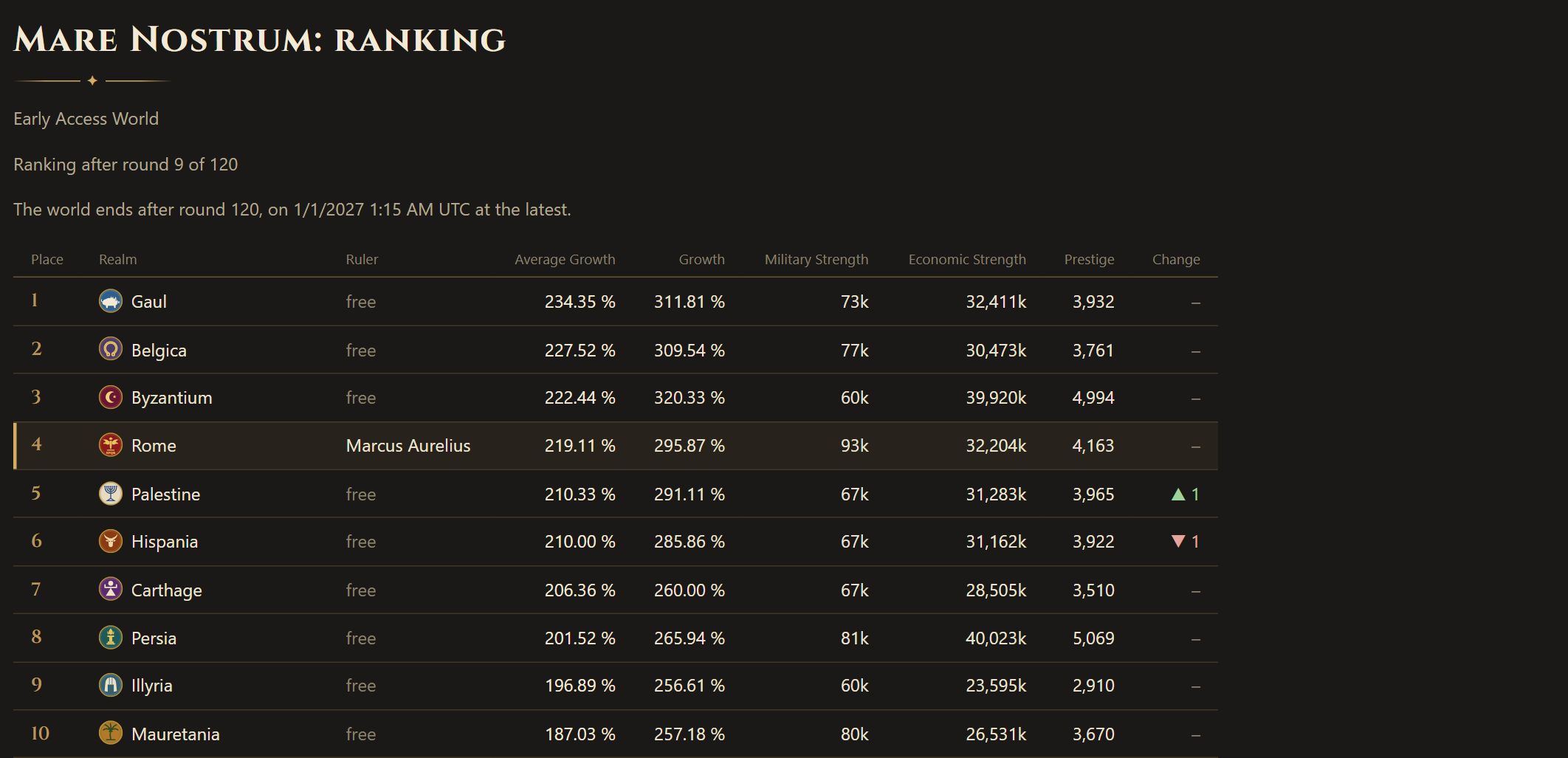
How each figure is made is under Score and ranking.
Read your land before you build
Before your first order, look at your realm on the map. Resource mode shows the deposits on your fields. Also check how dense your provinces are, where your trade centres are, and who your neighbours are.
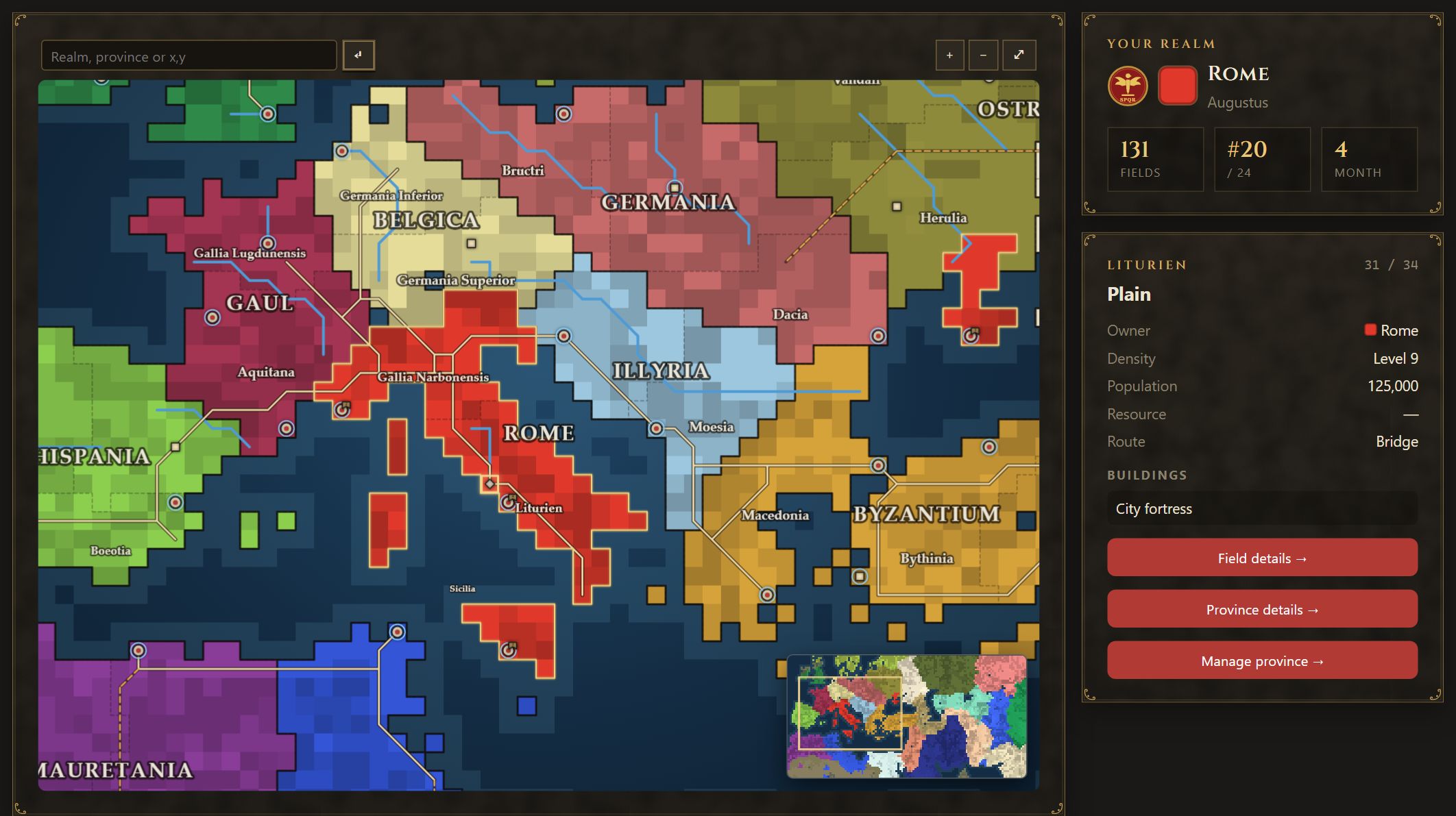
Then set a goal for the next half year. What should your realm look like six rounds from now? The goal tells you what to build:
- For a strong army: an armoury with its suppliers, plus horse studs if your best troops ride.
- For a fleet: timber camps, weaving mills and an oil well, because ships need wood, textiles and oil. Warships also need slaves as oarsmen, and those do not grow back.
- For money: luxury goods, a gold mine with a mint, and a trade centre.
Turn that into a build plan: which manufactory goes in which province, on which field. Terrain, density and deposits decide what may stand where. Each manufactory's conditions are listed under Manufactories.
Food first
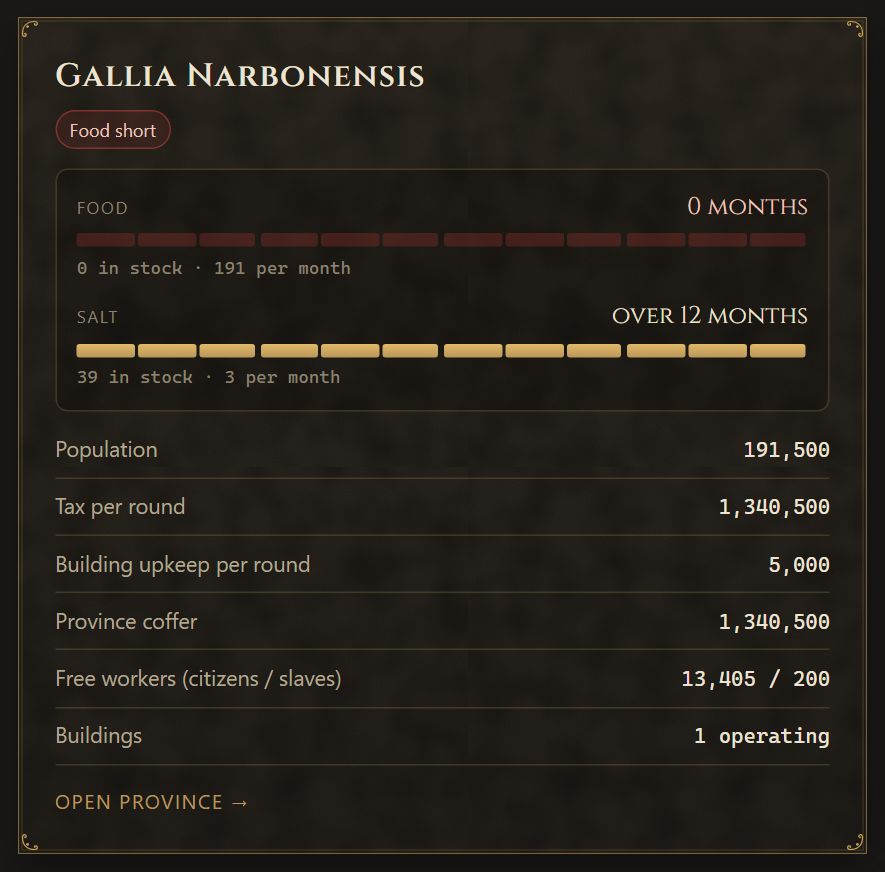
Hunger costs you population. When food runs short, your fields lose density, the densest first. With the people go your taxes and your workers.
- Only latifundia produce food, and they yield much more in the warm months. Build them early in the year, not in autumn.
- Plan for more than you need today. Your population grows, and its appetite with it.
- A surplus at the end of winter can be sold. Citizens who starve do not come back.
- Without salt your population grows more slowly. A salt works needs a salt deposit on its field; if you have none, buy salt at the market.
What each good is for
- Armour points
- The most important good in the game. You need them to raise and train troops and to build ships and fortresses, and you can sell them too. You never have enough, so start producing them early.
- Ore
- The raw material for armour points. Not every region has it. If you lack it, buy it at the market, even at a high price.
- Wood
- For armour points, ships and trains. Some realms build their fortresses from wood instead of stone.
- Stone
- For fortresses and projectiles. It sells for little.
- Horses
- For cavalry and elephants, one horse per man. Every new train needs many as well.
- Slaves
- As workers they raise a manufactory's output without tying up citizens, and they row your warships. There are no revolts, so a manufactory may run on slaves alone. No building makes them, and they wear out at work. You have your starting stock, what you buy at a trade centre or conquer, and whatever demolition and scrapping return. Put them where you are shortest of a good. More under Slaves.
- Luxury goods: gold, myrrh, crimson, amber
- The most valuable goods at the market. A mint turns gold straight into money, but it only works with a high working factor.
Every good with where it comes from and what it is for is listed under Goods.
Plan your production chains
The armoury takes ore, wood and textiles from its province's stock. Weaving mills make textiles from wool, and wool comes from cattle farms. One cattle farm yields little, so a mill needs several of them.
- Build the whole chain in one province. Goods reach another province by train or by ship, and that costs rounds.
- Trains are expensive to build but cost no maintenance. Off the roads they wear down, and a train that gets too weak is lost with its cargo. Repair it in time (Trains).
- Your ships need textiles too. If you want an army and a fleet at the same time, your mills must supply both.
- Check the province page every round. It shows each manufactory's expected output and, if it stands idle, why.
Making money
Taxes alone will not pay for a strong army. You earn the rest at the market of your own trade centre.
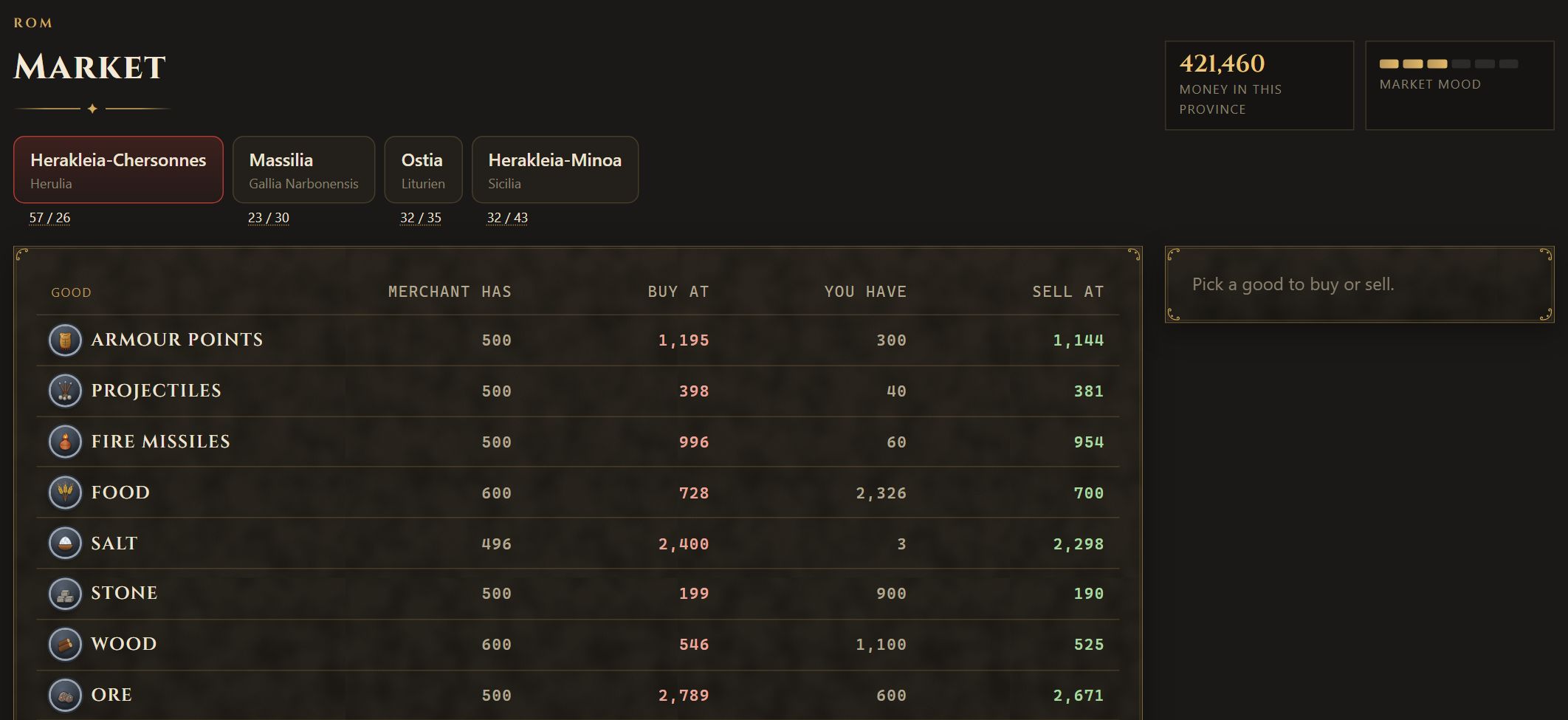
- Market mood changes every month. When it is high, everything is expensive, so that is when you sell. When it is low, you buy.
- Selling a large amount at once gets you less per unit. Spread big sales over several rounds.
- Now and then a travelling merchant stands at one of your trade centres for a month. Its mood can differ from the centre's by up to five, so buy from the cheaper one and sell to the dearer.
- Luxury goods earn the most, followed by oil, ore and salt.
- If you need money fast, mint your gold.
- A lone trading ship under the Standing Order Trade may sail every realm's waters, even in a war, as long as it carries no citizens, horses or war goods (Standing Orders).
Keep an eye on maintenance
Legions, ships, commanders and manufactories cost maintenance every month. It is charged before taxes come in, so it comes out of whatever money is left at the end of the month.
- Next to the treasury you see the next round's maintenance. Keep at least that much in the treasury before you end your turn.
- If the money runs out, your depots pay, with a surcharge. Whatever is still missing costs you soldiers first, then ships, then commanders, then manufactories (Maintenance and bankruptcy).
The army: raise steadily, train well
- Raise troops every month. Your realm may raise only a limited number of legions per month. Once you fall behind you will hardly catch up, because your neighbours raise troops too. So raise a few even in lean months.
- Start small. You can raise cohorts with few men and replenish them later, which saves citizens and armour points. Only the more expensive last legions and cohorts of a month must themselves be at full strength; the others need not be.
- Keep above the minimum strength. Marches and battles cost men. A cohort below its minimum dissolves, and so does a legion with too few cohorts. Replenish in time.
- Choose quality over price. Look up your realm's unit types under Troops and find the best ones. Cheap troops save money, but money alone wins no war.
- Train your troops on one of your own depots before you send them out. A cohort without experience costs a lot and achieves little. More experience also means more maintenance, so plan for it.
Diplomacy and war
Diplomacy, commanders, field armies, conquest and land battles are built, and a world runs them from round 1; a world opened before they were built runs them once an Announcement has switched them on (Announcements). How a battle is fought is in the guide (Land battles); battles at sea are still to come (What is still to come).
- Get to know your neighbours early. Most realms start with no neutral land next to them, so the only way to grow is at someone else's expense. A war on several fronts at once is very hard to win.
- Any legion that marches over neutral land takes it, with or without a commander, but never on a forced march. If two realms reach the same neutral field in the same round, neither gets it.
- Your status toward a realm decides what it may do in your land, not the other way round. Trade lets its trains and trading ships through, a Military Alliance its legions and warships too. Nobody ever sees another realm's forces, allies included, so open your borders to legions only for a realm you trust.
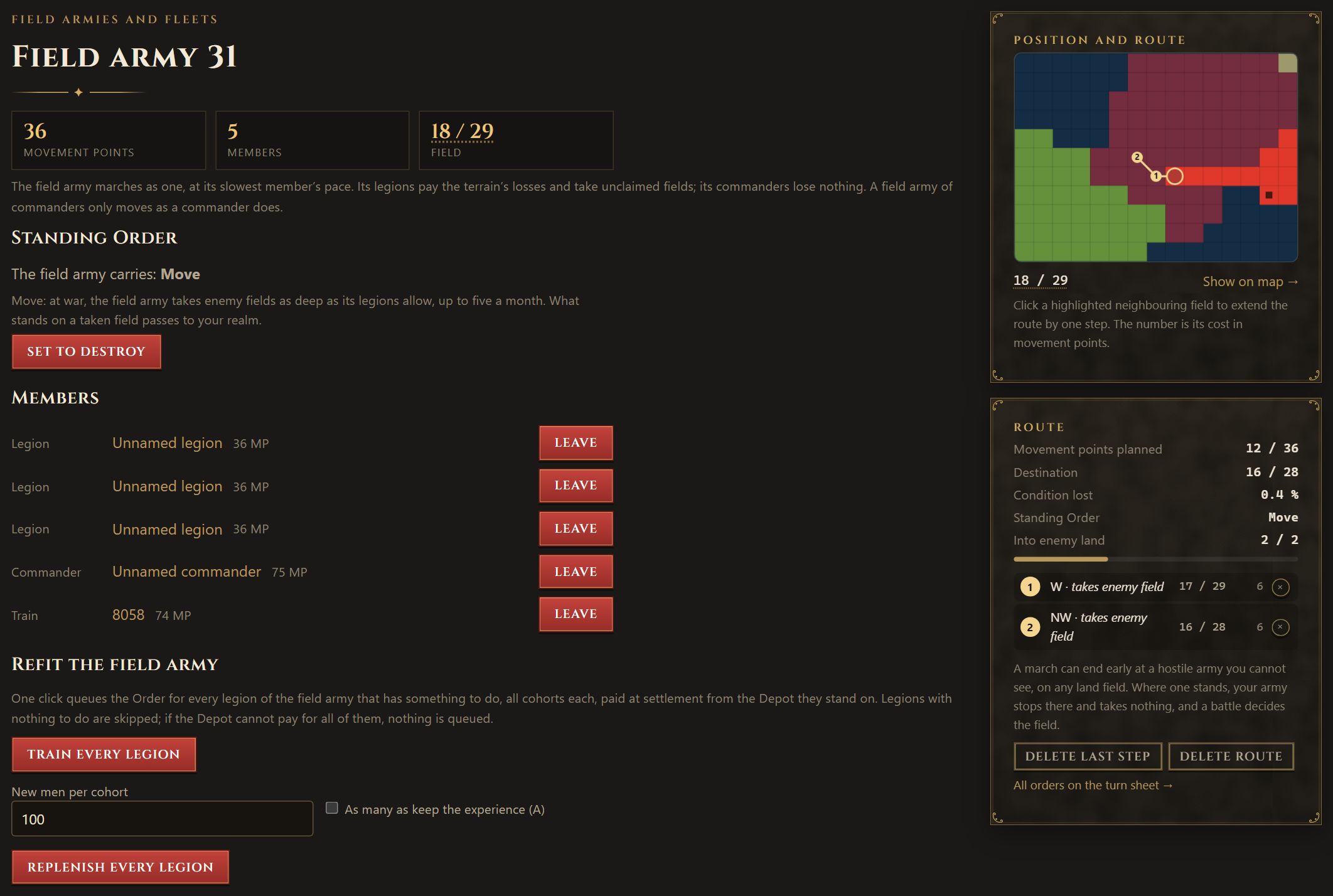
- A war needs a field army with a commander and at least one legion. The more legions it holds, the deeper it gets into enemy land in one month. War can be declared no earlier than in the orders for Aprilis 200, and it ends only when both sides have returned to Neutral.
- You do not recruit commanders. Your realm receives them according to its number of legions; if you lose legions, the weakest commanders go first. Your best commander on the field leads the battle, and if that side loses too many men, the commander falls.
- Decide beforehand what you want from a war: beat the enemy army, knock out the enemy's armouries, or gain land. Pursue one main aim and do not spread yourself thin.
- Choose the Standing Order with the field in mind. Under Move, what stands on a taken field becomes yours. Under Destroy the depot or manufactory there is razed with its stock, which hurts the enemy but leaves you nothing.
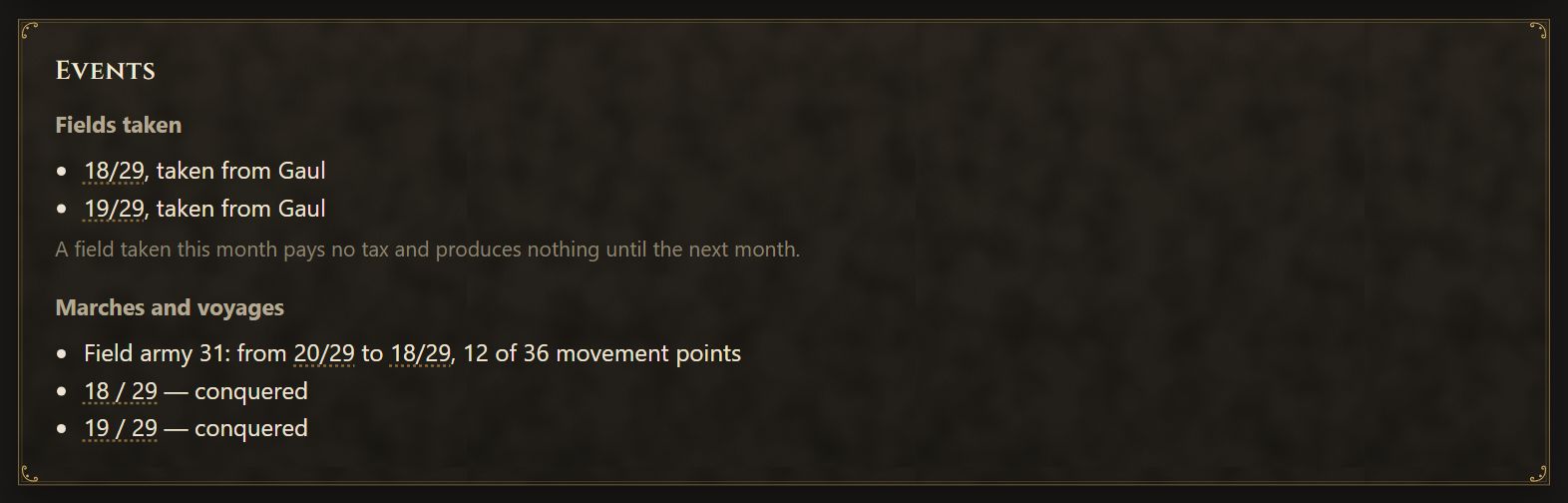
- A conquered field earns nothing in its first month, and the citizens in its depot and manufactory are lost. Plan the money and the people for the next step before you march.
- Watch the ranking. In a world that shows Military Strength, a neighbour whose figure jumps is arming, one round late and without saying where.
- Plan for what you cannot see. You do not see foreign armies beforehand. If your march meets an enemy army that stood still, it ends there and takes nothing. Enemy armies already sharing a field fight only if one of them orders the attack.
- Concentrate your forces. Battles are calculated in the settlement with no dice: numbers, quality, experience and the terrain decide. Bring your army together at the decisive point instead of spreading it along the border. Between armies of similar strength, expect a draw, which takes no field.
- Keep small legions away from the enemy, or small enough that losing them does not hurt. Nobody retreats after a battle: a beaten army stays where it stands.
When things go badly
Do not give up too soon. A world ends only after its last round, and a war lost head-on often leaves other paths open: fall back, hold a core, find allies against the attacker. In a new world your average over the last rounds is what counts, so a setback drops out over time if you rebuild soon enough. A position that looks hopeless is your chance to make a name for yourself.
What is still to come
These rules belong to the Original but are not playable yet. If one of them comes to your world, an Announcement tells you beforehand. The current state is under Still to come.
- Senate. Its approval will decide whether you may raise troops, build ships, assign workers or declare war. It falls every month, war and hunger push it down further, and gifts to senators raise it.
- Battles at sea. Enemy ships on the same water field will always fight, and piracy is part of it. Until then your warships cannot fight but still cost maintenance, so do not build them too early.
- Embarking. Legions will sail on ships and can go down with them. Until then your army cannot cross the open sea.
- Spies. They will uncover what otherwise stays hidden, such as the statuses between other realms.
- Raising population density. By one level per field and round. Mind the manufactory on the field then, because each one works only within its density band.
- Trade by ship and train. Your ships and trains will trade at other realms' trade centres and with the merchants standing there.
- Ceding fields and ships, swapping registration numbers. A swap protects a legion in a bankruptcy, because the lowest number goes first.
- Chat. The players of a world will be able to write to each other directly. The game does not enforce what you agree there.
Storms, ship ageing, epidemics, slave revolts, the jumps to Africa and China with the silk and slave trade there, and the simulated battle are not part of the Original. You need not plan for them.