
Help
How Ferrum et Fluctus works: games and host settings, rounds, score, economy, army, fleet, conquest and diplomacy — and the order in which a month is settled.
Overview
Ferrum et Fluctus is a turn-based strategy game set in the Roman Empire and its neighbours. Each game is a world of its own. You join it, pick a free realm and govern it as its ruler. Your task: feed your people, produce and trade goods, keep an army and a fleet, and grow your territory.
A game starts in Ianuarius 200 A.D. One round is one game month. It appears as a Roman numeral beside its Latin month: round IV is Aprilis 200, round XIII is Ianuarius 201. When the host creates a game, they set how many rounds it lasts, the most real time a round may take and the other host settings.
Under Games you can see the running games and join one.
Games and host settings
Every game is one match from its first round to its last, and several run side by side. Each runs a variant: the rules and the numbers it plays with. Today every game runs the Original. Its values may still change while the game is in Early Access; a change reaches every game from its next settlement.
The host chooses the host settings when creating a game. A game created without choices gets the Original's defaults:
- Rounds
- 120 rounds (ten game years) by default, at most 256.
- Round length
- 12 hours by default. The host may change it between 1 and 24 hours, effective from the next round, unless they fixed it for the whole game at creation; a fixed round length may also be longer than a day.
- Sign-up period
- None by default: the game starts at its creation and you can join at any time. With a sign-up period, every realm starts at the same moment.
- Late joining
- Open to the end by default. The host may close it after a cut-off round.
- Abandoned realms
- By default a realm whose ruler is gone stays intact for a newcomer. The host may choose that it dissolves instead.
- Rules
- Every mechanic built when the game is created runs from round 1. By default a mechanic built later is switched on by an Announcement; the host may freeze the rules at creation instead.
- The end
- By default the fog stays when the game has ended. The host may choose that it lifts.
Joining before the start: sign-up period and Realm Draw
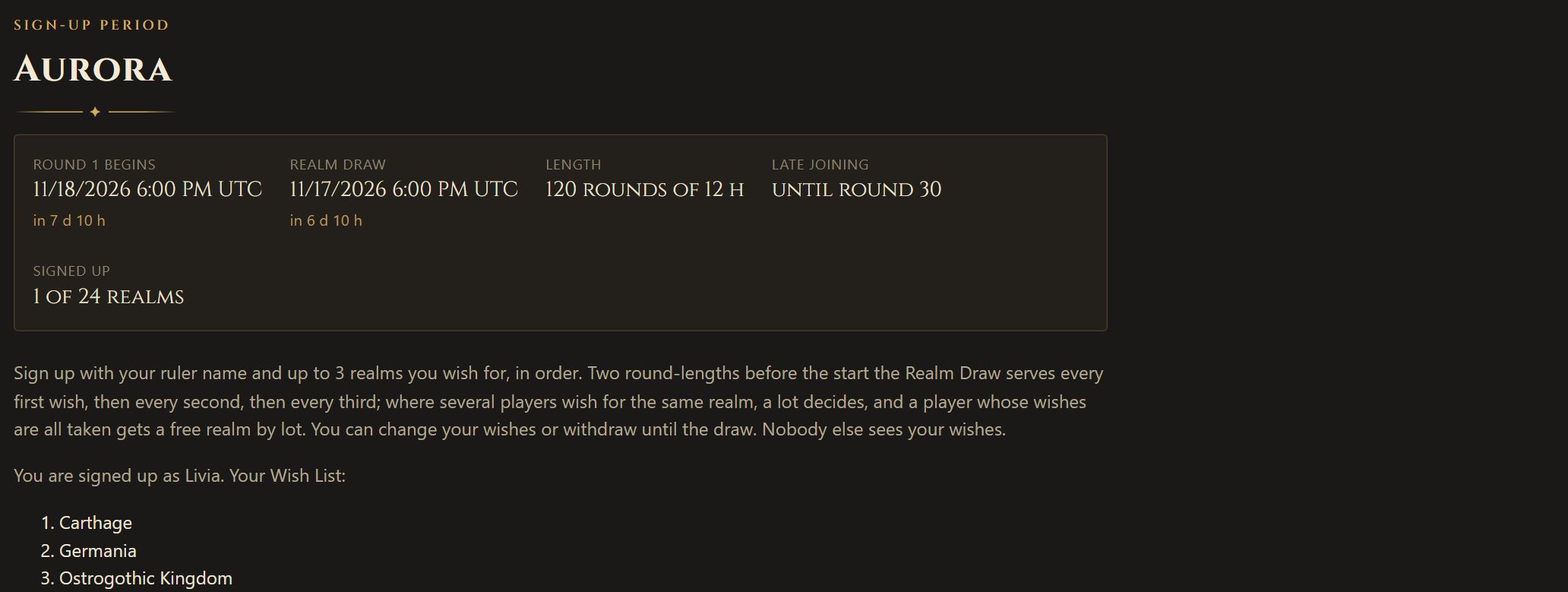
- Sign-up period. Where the host chose one, a game takes sign-ups before round 1. You sign up on its page with your ruler name and up to three wished realms, in order. Until the draw you can change your wishes or withdraw. Nobody else sees them; the others see only how many have signed up.
- Realm Draw. Two round-lengths before round 1 (two days at 24 hours per round) the draw serves every first wish, then every second, then every third. Where several players wish for the same realm in the same place, a lot decides. Whoever gets none of their wishes draws a free realm by lot. From then on everyone sees who rules which realm.
- Until round 1 you can read your realm and the map, but no Order is accepted. Round 1 begins at the start date the host set, for every realm at once, with whoever signed up. A realm nobody drew stays free.
- If every realm already has a sign-up, the game is full, and the page offers the notify list instead.
Late joining and the Cut-off Round
A game takes newcomers until its cut-off round: anyone may claim a free realm through the Join page. The host sets that round at creation. Without one a game stays open for its whole life, unless its abandoned realms dissolve: then late joining closes at the end of the first quarter of the rounds, round 30 of 120 for example. After the cut-off round the seats are fixed.
When a seat is lost
A seat with no Order for about a week is released, in every game. The Join page names the exact number of rounds for its game. What happens to the realm depends on the host setting:
- Taken over (the default): the realm stays exactly as it is, and anyone can claim it through the Join page. Nothing is ever dissolved.
- The notify list. When no realm is free, the Join page lets you watch the world and put yourself on its notify list. Everyone on it gets one e-mail when a realm frees up, and whoever claims it first gets it.
- Dissolved: a realm whose seat was lost, by absence, by leaving or by the operator, stays claimable until the cut-off round. Its settlement dissolves every realm that once had a ruler and has none; after it, a realm dissolves in the settlement that finds it without one. A realm nobody ever ruled never dissolves.
A dissolved realm:
- loses its army, its ships and its trains;
- its fields become neutral land that anyone may conquer;
- its depots and harbours stay, with their goods but without their citizens;
- from the next round on it loses 65% of its remaining manufactories every round, rounded up, and from the round after that its fields lose one level of population density every second round, never from 1 to 0, until someone conquers them.
The end of a world
- A world ends after its last round, and only then: not on a date, and not by conquest. The ranking page always shows the number of rounds and the latest date the world can end. In the last six rounds every game page carries a banner: "This world ends after round …".
- The last settlement freezes the Final Ranking and closes the world. From then on it takes no Orders and can only be read. It stays on the games list for a month; under Finished games you keep every world you ruled in or hosted, with your place.
- Where the host chose it, the fog lifts. Once the last round has settled, every signed-in player can read every realm's Final State: its forces on the World Map and on the field pages, and on the realm's own page its treasury, the stock of each depot, its buildings, fortresses included, and a list of its forces. Round Reports, diplomatic statuses and queued Orders stay private. A game whose fog stays has no Final State.
Who hosts a game
- Only an account with the Hosting Right can create a game and so become its host; the operator creates games too. An administrator grants and withdraws the right; withdrawing it stops new games, never one already created. A host may run at most three games that have not ended yet, unless the administrator sets a different limit.
- The host sets the name and the host settings. With a sign-up period they may move the start date until the Realm Draw, and cancel the game until round 1; a cancelled game is deleted.
- A host may hold a seat in their own game. While they do, they cannot force a settlement: a round ends at its deadline or when every seat has ended its turn.
Announcements
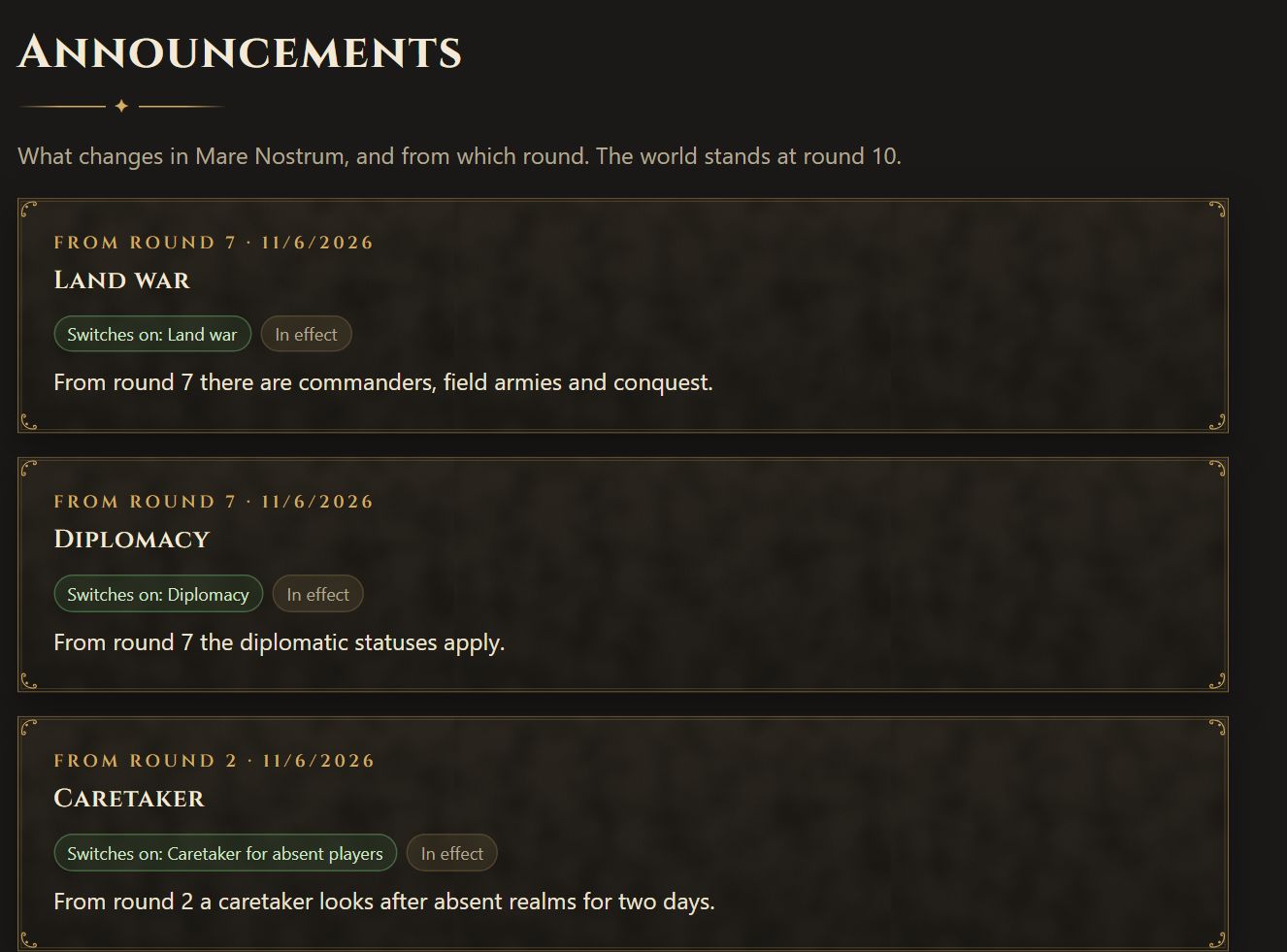
Every world keeps its own list of the mechanics it runs, each with the round from which it applies. A new world starts with every built mechanic from round 1. Where the host froze the rules, the list is fixed when the game is created. Otherwise it grows when a mechanic is built after the world started, and only through an Announcement:
- The operator publishes it, in German and in English, on the world's Announcements page. It names the round from which it applies. "From round n" means the month you see in the game: the change is in your Orders while the world stands at round n, and the settlement of round n is the first to apply it.
- Notice: at least one round ahead. A mechanic that brings conflict between realms, that is diplomacy and land war, needs at least six rounds' notice. An Announcement may also switch nothing on and only tell you something, such as a change of a value.
- While you have an Announcement you have not seen, every game page shows a banner. It goes once you have opened the Announcements page. Whoever takes over a realm starts with every Announcement unseen.
- An Announcement cannot be changed or withdrawn. The next Round Mail carries it too.
Rounds and turns
An order takes effect in one of two ways:
- Immediately
- Orders that touch only your own realm take effect when you click: ordering a depot or a manufactory, upgrading, assigning workers, moving money, building a ship, forming a field army or a fleet, trading at the market. What is paid at once cannot be undone.
- Queued
- Orders that other realms can affect wait for the settlement: above all the movement plans on the turn sheet, but also raising legions, changing a Standing Order or a diplomatic status. You can change or withdraw them until the settlement; they are paid only then.
Ending your turn
When you are done with a month, click Next turn on the realm page. Your plans are frozen from then on. Until the settlement starts, you can retract your turn. Once every player has declared, the round is settled.
A player who never declares does not hold everyone up forever: each round has a round deadline. When it passes, the round is settled whether everyone is done or not. A host who holds no seat in the game can also force a settlement at any time.
While a round is being settled the game takes no orders, and the game pages show a holding notice. Afterwards your Round Report shows what happened.
While you are away
Only an Order counts as playing: logging in, reading the map and ending your turn do not. A run of rounds without an Order is an absence, and it ends with your next Order.
- The first two days: the caretaker. In a world that runs it, for the first rounds of an absence that make up about two days (four rounds at 12 hours per round), a caretaker looks after your realm once per round. It builds at most one manufactory on your first field with a resource, raises at most one legion or tribe, and puts citizens into empty manufactories. It goes through the same rules as your Orders, pays from your realm's own money and goods, and never spends below next round's maintenance. It never moves your army, and it does not end your absence. Your Round Report lists what it did. After two days it stops.
- After a week: the seat is released. A seat with no Order for about a week (14 rounds at 12 hours per round, 7 at 24, never fewer than 2) is released. About a day before, you get a Release Warning by e-mail. What becomes of the realm is in When a seat is lost.
How a round is settled
The settlement works through a month in a fixed order. The order explains things that might otherwise surprise you: maintenance, for instance, is charged before tax comes in, so it is paid from the money you had left at the end of the month. Steps that belong to a mechanic run only in a world that has it switched on.
- The month advances.
- Food and salt: the population consumes what it needs from the depots. Where something is missing, there is famine (see Economy).
- Maintenance for army, ships, commanders and buildings is paid, by bankruptcy if need be (see Maintenance and bankruptcy).
- Army: new legions and extra cohorts are raised; cohorts are replenished, trained, swapped and merged.
- Completions: buildings, fortresses, ships and trains are finished, ships and trains are repaired, new legions muster, upgrades are done.
- Removals: disbanded legions and trains and scrapped ships are gone, demolished buildings fall.
- Caretaker: for a player in the first two days of an absence, one manufactory, one legion or tribe and citizens for empty manufactories (see While you are away).
- Standing Orders: queued changes take effect, before anyone marches (see Standing Orders).
- Movement: every legion, field army, commander, ship, fleet and train carries out its plan, with loading, unloading and conquest.
- Conquest aftermath: on fields taken from another realm the buildings pass to the conqueror, or are razed under Destroy (see Conquest and its aftermath).
- Trains worn down below 10 movement points are lost with their cargo.
- Land battles are fought where hostile armies met (see Land battles). A field a battle takes passes as in any conquest.
- Diplomatic statuses: queued changes take effect, after the battles, which read the statuses as they stood when the round began.
- Commanders: your realm is brought to the number of commanders its legions call for.
- Tax: half into the treasury, half into the province's depots, computed from the previous month's population. A field taken this month pays nothing.
- Production: manufactories produce their goods.
- Next round's maintenance is calculated in advance.
- Epidemics strike, in a world that runs them (see Epidemics).
- Population grows or shrinks.
- Understrength cohorts and legions are lost.
- Absent seats: a seat absent for about a week is released; where the host chose dissolution, a released realm nobody claimed in time dissolves.
- Ranking: the Live Ranking of this round is written, and your Round Report is complete. After the last round the world closes.
The Round Report
Under Report in the game navigation you read what each settlement did to your realm. Only the ruler of the realm can read it; the host and the administrators see nothing more. It has five parts:
- Changes to the realm
- Tax per province, production, food and salt, population growth, maintenance and any bankruptcy, construction finished, legions mustered and ships launched or repaired, foreign ships you repaired in your harbours, disbanding and scrapping with what came back, understrength cohorts and legions lost, Standing Orders changed, worn-out trains, what the caretaker did, epidemics in your manufactories, and the diplomatic statuses you changed.
- Events
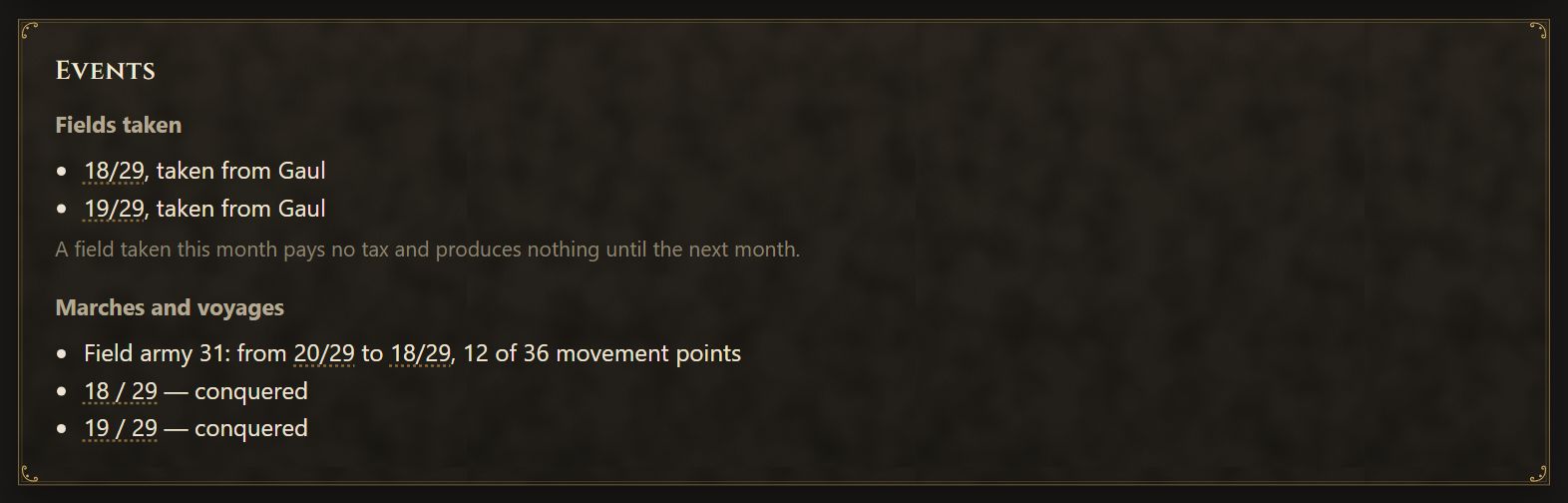
- Every battle your realm fought, with a link to its Battle Report; fields taken and lost, fields plundered by you and from you, what was lost with the buildings taken, every march and voyage, other realms at your depots, and your ships at foreign depots.
- Statuses newly held toward you
- Which realm changed its status toward you, and to what.
- Refused orders
- Every queued Order the settlement could not carry out, with the reason.
- World Map changes
- Every field that changed owner this round, and every field an epidemic struck.
What the report deliberately leaves out:
- Other realms' forces. No report shows you a foreign legion, field army, commander, train or ship. An enemy army standing on one of your fields stays hidden until it conquers, fights, or a spy counts it.
- Anything between other realms, including the statuses they hold toward each other. Another realm is named only where the World Map shows it anyway, as the owner of a field.
- Whether other players are present, absent, done with their turn or covered by the caretaker.
A report is written once and never changed. The round list at the top takes you to any earlier round of the world. The reports belong to the realm, not to the player: whoever takes over a realm reads all its earlier reports, and whoever left it reads none. Spies' findings will join the report when spies exist.
Staying in touch
The game reaches you by e-mail only, in the language you choose:
- Round Mail
- After each settlement of a world whose rounds last at least 12 hours: the round just settled, the next round deadline, your place in the ranking, the world's Announcements, one line per part of your Round Report and a link to the full report. It is a summary that points to the report, not the report itself.
- Deadline Reminder
- Only in worlds whose rounds last at least 48 hours: 24 hours before the round deadline, if you have neither given an Order nor ended your turn in that round.
- Release Warning and Release
- About a day before your seat is released for absence, and when it has been. These two cannot be switched off.
Under Notifications in your account menu you switch the Round Mail and the Deadline Reminder on or off and choose the language of the mails: German, English or both. To talk to other players, open the Chat in the world's navigation: to one realm, to a group of realms, or to the whole world. A Chat has no effect on the game and sends no e-mail; you can switch its small corner notice off under Notifications as well. You read what was written while you held a realm in that Chat, and whoever takes a realm over after you does not read your time. The ⋯ beside another player's message lets you block that player, whose messages you then no longer see in any world, or report the message to the operator; the reply appears on your start page.
Score and ranking
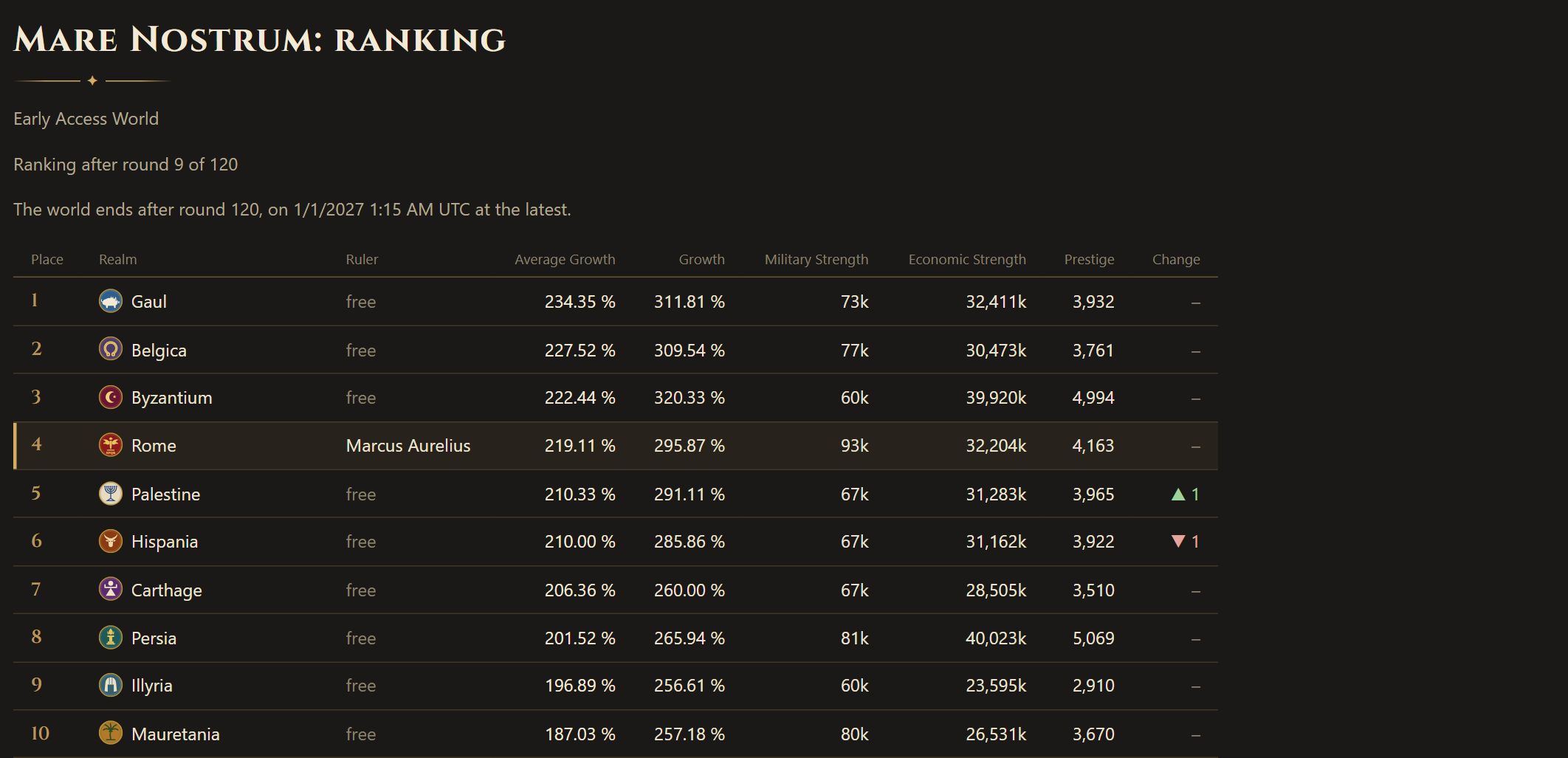
Every world keeps a ranking of all its realms, free ones included. You find it under Ranking in the game navigation and on the games list. Every signed-in player can read it, including players without a seat in that world.
- Prestige
- A realm's score: one point per 1,000 inhabitants that the population density of its fields stands for, and 10 points for every building on its fields that the World Map shows (depots, trade centres, manufactories). A building counts from the moment it is placed, for the realm whose field it stands on. In a world created since 6 November 2026, Prestige adds 5 points per 1,000 of Military Strength and one point per 10,000 of Economic Strength.
- Military Strength
- Over every cohort of the realm's ready legions: its men times its unit type's fighting value, the mean of its eight terrain values in melee plus its ranged value. Legions still mustering, experience, commanders and ships do not count.
- Economic Strength
- In money: the treasury, the money in the realm's stores, every other good in its stores, ships and trains at a fixed reference price (not the market's), the money put into its buildings (starting buildings count nothing), and its ships and trains at their build cost, scaled by their condition.
- Growth
- A realm's Prestige now as a percentage of its Prestige at the world's start. Every realm starts at 100%, so a small realm and a large one compete on what they make of what they were given.
- Average Growth
- The mean of a realm's Growth over the world's last 12 settled rounds, or over all of them while there are fewer. In a world created since 4 November 2026 realms are ranked by it; an older world ranks by Growth itself. A world keeps the formula it was created with.
Military and Economic Strength are measured once per round, when it settles, and rounded to the nearest thousand; the ranking shows them in thousands and computes Prestige from the rounded figures. Nothing finer is revealed: neither where an army stands nor what a depot holds.
- Live Ranking. Each settlement writes the ranking of the round it settled. It is the same for everyone until the next settlement, so an Order you give now shows only after it. The page heads "Ranking after round n of N", shows the latest date the world can end and each realm's change in place since the round before. Before round 1 has settled it shows the start.
- Ties. Realms with the same ranked value, to the hundredth, share a place, and the next place is skipped (1, 1, 3). Within a tie the higher Prestige is listed first. At the start every realm is first.
- Final Ranking. The Live Ranking of the last round, frozen when the world closes. Nothing is reordered at the end, and it names the victor.
- Tenures. The place belongs to the realm. A ruler is credited through their tenures: the runs of rounds in which they held the realm, for example "Marcus, rounds 1–34; Livia, rounds 41–120", each with the Growth at its first and last round. A finished world's ranking page shows the tenures and every realm's place round by round.
- Every realm on the ranking links to a page. Yours opens your realm; any other opens its public page with its ruler, its ranking line, its number of fields and its provinces: only what the World Map shows anyway.
Realm, provinces and map
The world is made of fields with terrain such as plain, hill, forest, swamp, desert or mountain. Fields belong to provinces. Your realm owns individual fields, so a province can be wholly or only partly yours.
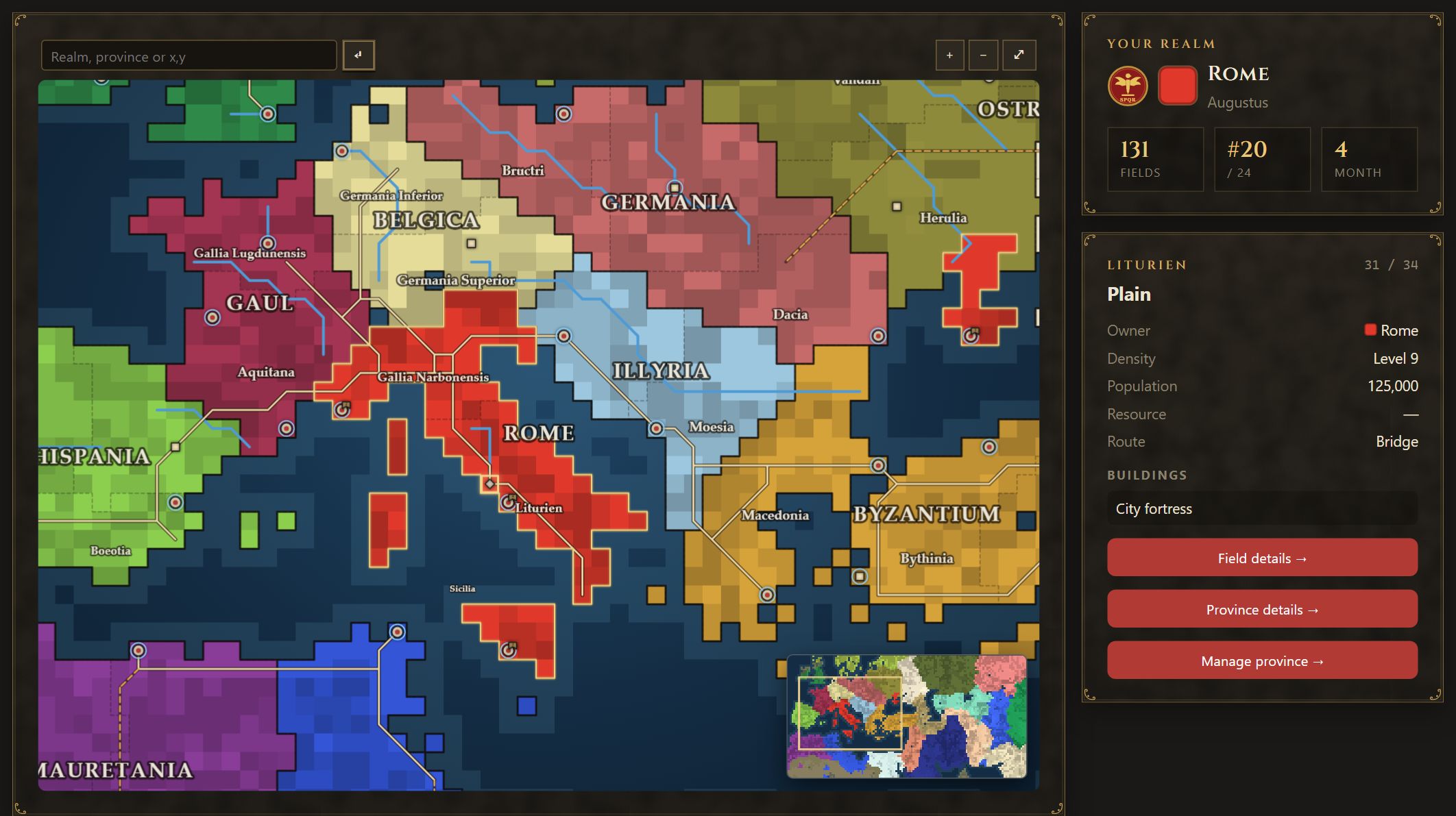
The map is the same for every player in a world: it shows who owns each field, how densely it is settled, which building stands on it and what the trade centres deal in. It does not show foreign legions or ships, except that a ship at sea is sometimes sighted. A field conquered this month is marked for one round. The map modes switch between the political view, terrain and resources.
Economy
Two purses
The treasury is your realm's central purse. It receives half of the tax and pays maintenance and the building of depots. Each province also has money in its depots, which receive the other half of its tax; from it the province pays for its manufactories and their upgrades, and a depot pays for the legions, ships and trains built at it. On the province page you can move money between the treasury and the province, or one named depot, freely and at no cost.
Depots and harbours
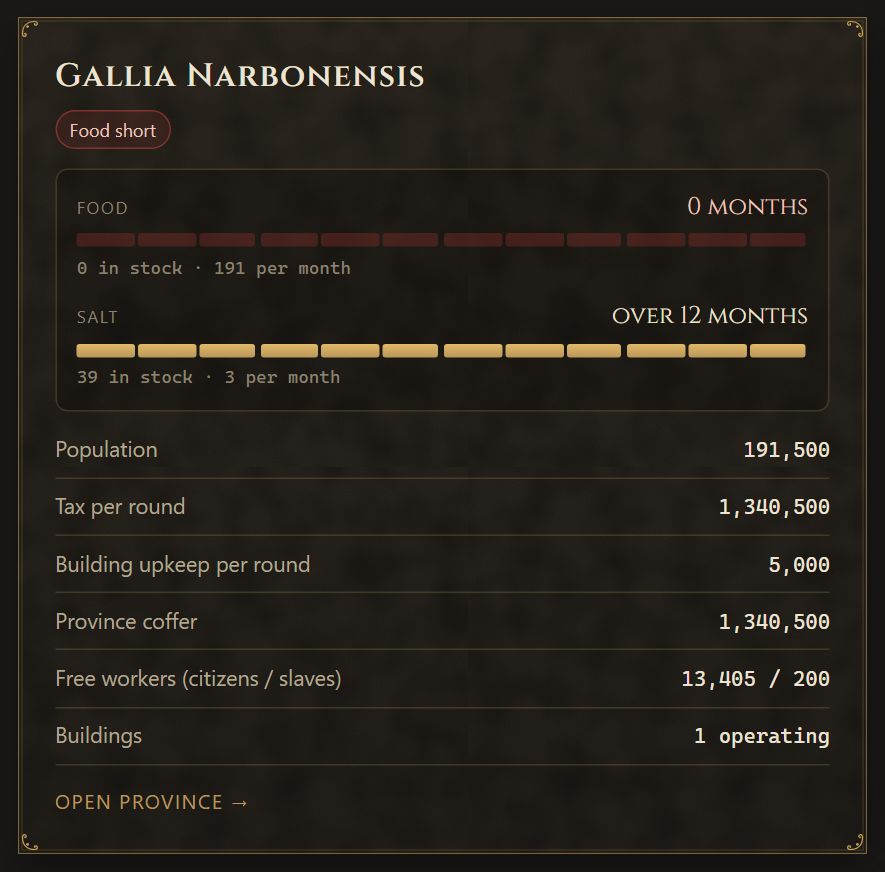
A depot is a province's store. Its goods sit there, up to a cap per good that grows with the depot's level. Legions are raised and disbanded at depots. A depot on or next to water is also a harbour: only there are ships built, repaired and scrapped. A trade centre is a depot that also has a market on its field.
Manufactories and workers
A manufactory produces one good each round: a latifundium food, a salt works salt, a timber camp wood, a myrrh field myrrh, mines ore, gold or amber, the armoury armour points, and so on. Some need a matching deposit on their field, some need raw materials from the store, some work only in certain seasons.
Every good with its icon, where it comes from, which manufactory makes it and what you need it for is listed under Goods. Every manufactory with where it may stand, what limits it, what it costs and how many workers each level takes is listed under Manufactories.
To produce, a manufactory needs workers: citizens and slaves from the province's store that you assign to it (on slaves, see Slaves). They determine its working factor, which sets the output. The province page shows a forecast for every manufactory and, when one stands idle, the reason.
- Building: the province pays at once; the building is finished in one of the following rounds.
- Upgrading raises a building to its next level. A manufactory stands idle for that one round; a depot keeps working.
- Demolishing takes one round. Part of the money invested and half the workers come back; stored goods move to the province's other depots. Demolish a province's last depot and its goods are lost.
Food, salt and population
Each month the population consumes food and salt from the depots. If there is not enough, population density falls field by field, the densest first, until the rest can be fed. When there is enough, the population grows within its province's range; growth varies a little from month to month.
More population brings more tax, but also eats more. You can raise it yourself, field by field (see Raising population density).
Raising population density
Every land field has a population density from 0 to 9, and each level stands for a fixed number of inhabitants. You raise it one field at a time, by one level.
Why raise it:
- Tax: each month a province pays its population times its tax rate, half to the treasury and half to its depots.
- Growth: the population grows by a share of itself, so a larger one grows by more citizens.
- Manufactories: each kind works only within a band of densities, listed under Manufactories. At density 0 none works, so a deposit on an empty field is no use until you raise it. A horse breeding, for example, works at density 1 to 3.
- Score: one point per 1,000 inhabitants.
The price: more inhabitants eat more food and salt each month.
How:
- On the page of one of your fields, under Orders on this field, or in the Population density list on the province page.
- The button shows the new level and the bill. Confirm, and the field rises at once.
- Where a raise is not possible, the page says why instead of showing the button.
When:
- Any time during a round while the game takes orders. It is an immediate order: done and paid when you give it, and it cannot be taken back.
- A field rises at most one level per month. You may raise as many different fields as you can pay for.
- Raising a field above density 3 needs at least 45% approval from the Economics committee. The senate is not built yet, so for now this is always met.
- You cannot lower a field's density on purpose. Famine and plunder lower it.
- Watch your manufactories: raising a field above its manufactory's band stops it producing. The page warns you before you do it.
How much: the province's depots and trade centres pay, in citizens and your realm's building material. Sixteen realms build in stone, eight in wood; the bill on the page names yours.
| New level | Inhabitants | Citizens | Stone or wood (t) |
|---|---|---|---|
| 1 | 2,000 | 2,000 | 80 |
| 2 | 5,000 | 3,000 | 120 |
| 3 | 10,000 | 5,000 | 200 |
| 4 | 20,000 | 10,000 | 400 |
| 5 | 30,000 | 10,000 | 400 |
| 6 | 50,000 | 20,000 | 800 |
| 7 | 75,000 | 25,000 | 1,000 |
| 8 | 100,000 | 25,000 | 1,000 |
| 9 | 125,000 | 25,000 | 1,000 |
The highest density a field can reach depends on its terrain: plain 9, hill 7, steppe 4, savanna 4, forest 3, mountain 2, swamp 1, desert 0. Water holds no population. Level 0 holds 500 inhabitants, except in the desert, where it holds none.
Slaves
Slaves are labour and a good at once. They work in your manufactories, row your warships and lie in the depot like any other good. Unlike the population they do not grow back, and no manufactory makes them. What you use up you have to buy or conquer.
How they differ from citizens
- More labour: in a manufactory a slave counts one and a half times as much as a citizen, and it takes four times as many slaves as citizens.
- No running costs: slaves use no food or salt and cost no maintenance. In return they are not part of the population and pay no tax.
- Tradable: citizens can be neither bought nor sold; slaves can.
- They survive conquest: the citizens of a taken building are lost; its slaves change hands.
- No revolts: slave revolts are not part of the Original, so a manufactory can run on slaves alone.
Where slaves come from
- Starting stock: your depots begin with a random supply, and some with no slaves at all.
- The market: you can buy and sell slaves at any trade centre of yours. They trade at the price level of timber.
- Conquest: the slaves in a taken depot or trade centre and among the workers of a taken manufactory pass to you (see Conquest).
- Returns: demolishing a manufactory returns half its slaves; scrapping a warship returns part of its oarsmen and of the slaves paid to build it.
Plunder brings no slaves for now (see Standing Orders), and the slave trade in Africa is not part of the Original.
As workers in manufactories
You assign slaves to a manufactory on the province page. They come from the store of the same province; if they are not there, bring them by train or ship. Withdraw them and all of them return to the store.
Citizens and slaves together give the working factor: ⌊√(citizens × 4 + slaves × 6)⌋. Because of the root the first workers bring the most, and each further one less:
- Level 1 (at most 250 citizens and 1,000 slaves): citizens only 31, slaves only 77, both full 83.
- Level 3 (at most 1,000 citizens and 4,000 slaves): citizens only 63, slaves only 154, both full 167.
The province page shows your world's limits for each manufactory.
Slaves wear out. A staffed manufactory loses part of its workers every month, up to 10% depending on its type, slaves in the same share as citizens. So check regularly whether you need to restaff; how much each manufactory loses is listed under Manufactories. While you are away, the caretaker assigns only citizens, never slaves.
As oarsmen on warships
Every warship needs slaves for its oar banks; a trading ship needs none. The harbour pays them when the ship is built. The fewer oarsmen aboard, the slower it sails; with none it manages a single movement point. A repair refills missing oarsmen from the harbour, and is refused if the harbour does not have enough slaves. More under Fleet.
Trains, storage and transport
- Building a train costs 100 slaves.
- In a depot slaves are under the same storage limit as any good. Assigned workers do not count towards it.
- Ten slaves weigh one tonne, so a train holds 15,000 slaves. Like every good except money they take one of the three kinds of goods a train or ship may load.
How you lose slaves
- Month by month, through wear in the manufactories.
- When a manufactory is demolished: half its slaves.
- When a building of yours is taken: every slave in it passes to the conqueror.
- When a field is plundered: a manufactory or depot is destroyed with everything in it.
- If you demolish a province's last depot its goods are lost, slaves included.
- In a world with epidemics, each epidemic halves the workers of the manufactory it strikes.
Maintenance and bankruptcy
Legions, ships, commanders and manufactories cost maintenance every month. The figure next round's maintenance beside the treasury shows the most the next settlement will charge. It is only a guide: you may spend so much that what is left will not cover it — but then bankruptcy applies.
If your realm cannot pay its maintenance, this happens:
- The treasury pays first.
- The depots pay the rest, with a 25% surcharge.
- Whatever is still missing is lost: first legions (soldiers desert), then ships (the crew mutinies), then commanders (an unpaid commander deserts), last manufactories (with their workers). Within each kind, the lowest registration number goes first.
Depots and harbours are never lost to bankruptcy. What it cost you is listed in your Round Report.
Army
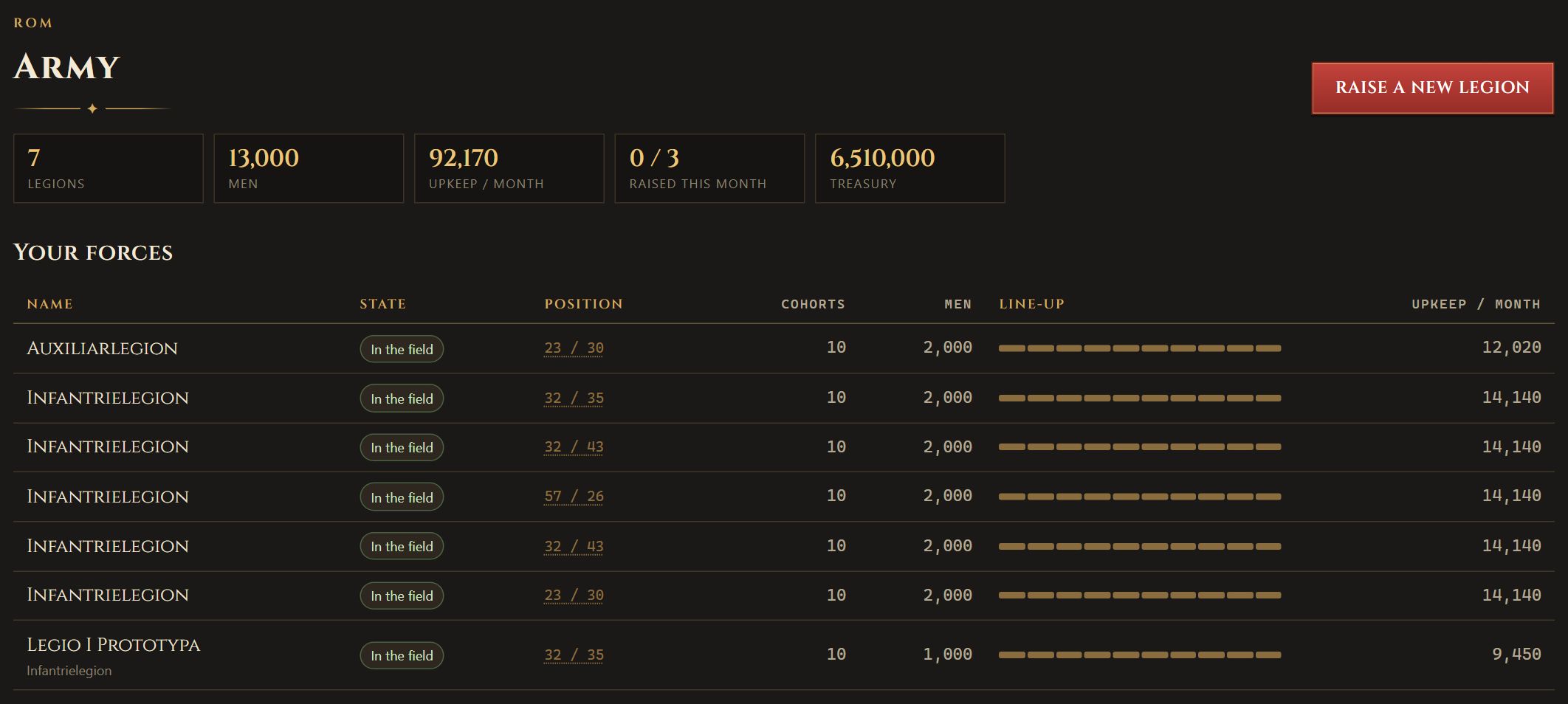
Your army is made of legions. A legion is what marches, costs maintenance and will one day fight. It is made of cohorts, and every cohort belongs to one unit type.
The terms
What the parts of your army are called throughout the game:
- Legion
- The smallest body of the army you move on the map. It has 14 numbered slots: the required slots 1–10 and the optional slots 11–14. Each filled slot holds exactly one cohort.
- Cohort
- One company in a slot of the legion. It has a unit type, a strength (how many men) and an experience. Every new cohort starts at the lowest experience.
- Unit type
- The kind of soldier, with its pay per man, armour points, combat values and speed. Every realm has its own selection, and the same type can cost different amounts in two realms. Every type is either regular or irregular; irregular cohorts may hold more men.
- Class
- The role of a unit type: heavy infantry, light cavalry, warriors and so on.
- Legion type
- A legion's recipe. For each required slot 1–10 it names the class the cohort there must belong to. It says nothing about slots 11–14. Every realm has one to four legion types.
Raising a legion
In your game's army, Raise a new legion opens the muster:
- Pick a legion type. The tabs at the top show your realm's legion types. The choice decides which class stands in each required slot.
- Fill required slots 1–10. Each card shows the class its slot requires and offers only unit types of that class. All ten must be filled, or the legion cannot be raised.
- Optional slots 11–14 can stay empty or take any unit type of your realm, whatever its class.
- Set each cohort's strength. The slider allows only the range the type permits; irregular types reach higher than regular ones. More men cost more, both to raise and to keep.
- Pick a depot. Under Muster at are your finished depots with their stock. Only those holding enough for this legion can be chosen. That is where the legion will stand.
- Give it a name if you like. You can change it later on the legion's page.
- Raise legion. The order is queued. You can withdraw it until the settlement, and it is paid only then. After that the legion stands on the depot, Mustering, until it is ready to march.
What a legion costs
The muster roll on the right of the muster page adds up as you go. Everything comes from the chosen depot:
- Money: the unit type's pay for every man.
- Citizens: one per man.
- Armour points, by the type's armour.
- Horses: one for every man of a mounted type, elephants included.
It all comes from that one depot, money included, not from the treasury or the whole province. If it is not there, move it there first or pick another depot.
How many legions your realm may raise per month depends on its culture; the muster page shows how many it has raised this month. The last of them cost several times as much, and the page warns you before you reach them. If you raise one of those more expensive legions, it must be at full strength: each cohort at the top of its range. The month's other legions may be weaker.
Once it is ready, the legion costs maintenance every month. The muster roll shows it in advance. It grows with each cohort's strength and experience.
Leading a legion
A legion's page shows its line-up slot by slot, and is where you give it orders. All of them are queued and carried out at the settlement:
- Raise a cohort: an empty slot takes a new cohort while the legion stands on a finished depot of yours. In slots 1–10 it must match the slot's class. It is paid like a raise, from the depot under the legion. There is a monthly limit here too, and the last cohorts of a month cost several times as much and must themselves be at full strength.
- Replenishing fills weakened cohorts with recruits. The new men lower the average experience. Training raises experience by one step, up to the type's ceiling. Both are possible only on a depot of yours, which pays for them.
- Reorganise cohorts: with another of your legions on the same field, or within the same legion, you can swap two cohorts. If either slot is among 1–10, both must be of the same class. Two cohorts of the same unit type can be merged: the second slot empties, the experience is averaged, and men above the type's maximum strength are lost. Reorganising costs nothing.
- Marching: you plan the route on the turn sheet.
- Disbanding is possible only on a depot of yours. Part of the men and goods return to it.
Every unit type, with its values in each realm, and every realm's legion types are listed under Troops.
Commanders
Commanders exist only in worlds where land war has been announced and switched on. In every other world your realm has none.
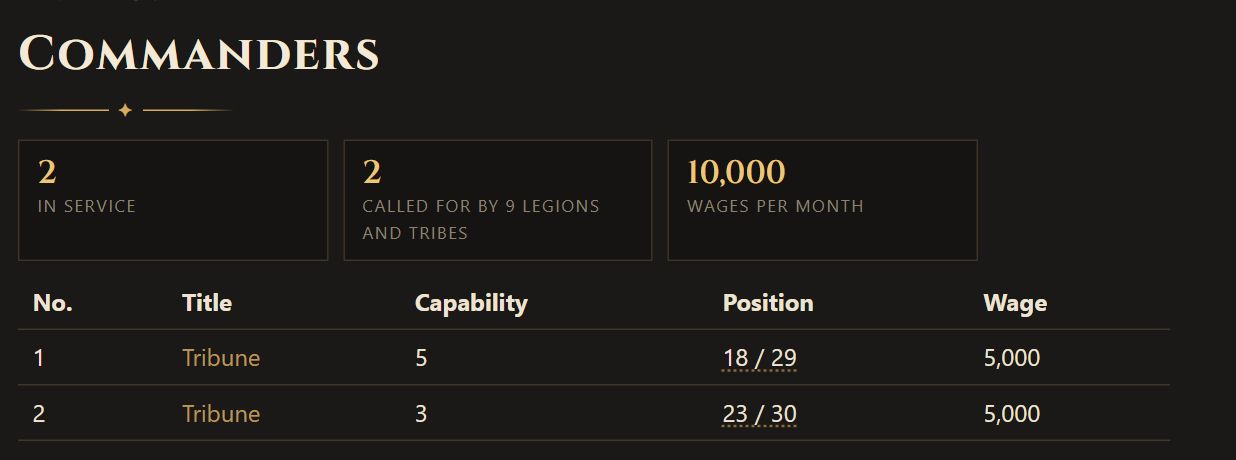
A commander leads your army. You do not hire him: your realm is given one commander for every five legions, rounded up, and at most ten. After every settlement the realm is brought to that number.
- A new commander takes the lowest free number from 1 to 10 and stands beside your legion with the lowest registration number. With no legion at all, none is appointed.
- Capability is how many cohorts he lifts by one step of experience in a battle. A new commander starts at 3 to 7; each battle his side wins raises it by 2, up to 30 (see Land battles).
- Title and wage follow from his Capability and your realm: a Roman tribune, legate, prefect or proconsul, a chieftain, prince or khan elsewhere. His wage is part of your maintenance.
- Too many commanders — because legions were lost or disbanded — means the weakest are dismissed, lowest Capability first.
- Moving: a commander marches alone at 75 movement points over any land field, foreign land included. He loses nothing on the way and conquers nothing.
Your commanders are listed under Army → Commanders, appear on the map and on the field page where they stand, and each has his own page: his title, Capability and wage, his march for this round, and a Service Record of what he has done in this game.
Field armies
Field armies exist only in worlds where land war has been announced and switched on.
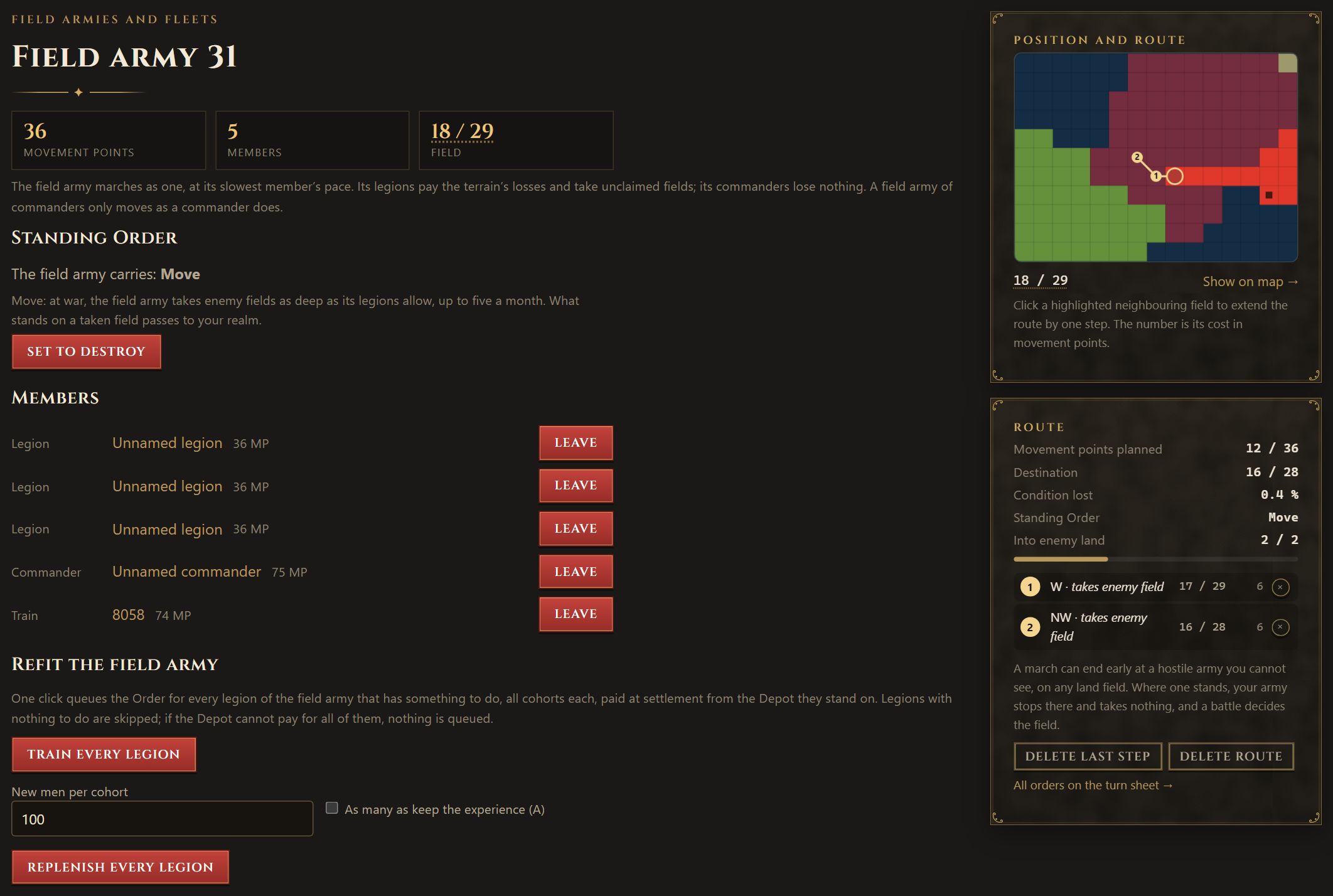
A field army is a numbered group of your legions, commanders and trains on one field, numbered 31 to 50. It marches as one, at its slowest member's pace, and has no size limit. Under Army → Field armies and fleets you tick forces that stand on one field and give a number:
- an unused number forms a new field army, and it marches in this very round;
- a used number joins that field army, straight from another one if need be;
- 0 takes them out again. A field army left empty is dissolved.
Every change takes effect at once, until you end your turn. Two field armies on one field can be merged: the one you name dissolves into the other, which keeps its number. A legion that joins loses its own march for the round, and while it is in a field army only the field army is given a march. Its legions pay the terrain's losses and take unclaimed land; its commanders lose nothing. A field army of commanders only moves as a commander does.
Only a field army with at least one legion and a commander may march into the land of a realm you are at war with; see Conquest and its aftermath. What it does there is set by its Standing Order.
On a field army's page, one click trains or replenishes every legion in it that stands on your Depot and has something to do. If the Depot cannot pay for all of them, nothing is queued.
Standing Orders
A field army, a fleet and a single ship each carry a Standing Order until you change it: Move, Destroy or Trade. You change it on its page. The change is a queued Order: it takes effect in this round's settlement before anyone marches, so the force already marches under the new order. Asking for the order it carries now withdraws a queued change.
- Move
- Every field army's and fleet's order, and the one a new field army starts with. At war, a field army takes enemy fields as deep as its legions allow, up to five a month, and whatever stands on a taken field passes to your realm. A ship under Move needs the owner's leave on foreign water: Trade for a trading ship, Military Alliance for a warship.
- Destroy
- For field armies. At war, the field army takes at most three enemy fields a month and plunders each one: the manufactory or depot on it is razed with everything stored in it (never a trade centre, never a fortress), and the field's population falls one level. A third of the inhabitants lost would be enslaved for the army's trains; for now they are lost too. Only enemy land is plundered, never a neutral field. At sea, Destroy means piracy, which comes with the sea battle; until then no ship can be given it.
- Trade
- Only for a single trading ship, never a warship, a fleet or a field army. It may cross the waters of every realm, even at war, as long as it carries no citizens, armour points, projectiles, fire missiles or horses. Borders open to it only in a world that runs diplomacy.
A ship in a fleet carries the fleet's order, so a trading ship that joins a fleet sails under Move. Trains carry no Standing Order yet.
Fortresses
Fortresses exist only in worlds where they have been announced and switched on. In every other world the province page offers no fortress building.
A fortress protects the field it stands on. You can build three tiers yourself: the small, the medium and the large fortress. The fourth, the city fortress, is built by no one.
- Where: only on a finished depot of your own, on firm ground (not desert, swamp or water), and not on a field that was just conquered. You order it on the province page under "Fortresses".
- Payment: at once and entirely from the stock of that depot, money included; the treasury pays nothing. On top come armour points and your realm's building material: stone, or wood in the realms that build in wood. If the stock is short, nothing is built and nothing is taken.
- Tiers: you can order several tiers at once, a large fortress straight away for example; every tier on the way is paid for. One fortress order per field per round.
- Timing: the order takes effect at once and cannot be withdrawn. The fortress stands after this round's settlement. While it is being raised, its depot cannot be demolished.
- City fortresses stand in the six ancient capitals from the start of the game. They can be neither built nor demolished, and protect whoever holds the city.
Fortresses do not appear on the map. In a battle on its field, a fortress strengthens its owner's cohorts (see Land battles).
Fleet
Ships are built in one of your own harbours. There are two kinds:
- Trading ship
- Carries cargo and needs no crew. Its speed depends only on its hull and its condition.
- Warship
- Needs a crew: marines from the citizens, oarsmen from the slaves. The oarsmen set its speed; without a crew it manages a single movement point. Which warships your realm may build depends on the realm.
- A ship is paid at once from the harbour's depot, money included, and the order cannot be withdrawn.
- A ship's condition falls as it sails and slows it down. Repairing restores it in one of your harbours. It costs goods and crew from that harbour, no money, and takes one round, during which the ship does not move.
- Scrapping in one of your harbours returns part of what the ship cost.
- A ship's own page shows what she has on board, takes her repair and scrapping, and keeps her service record: launch, voyages, loads, unloads and repairs.
Fleets
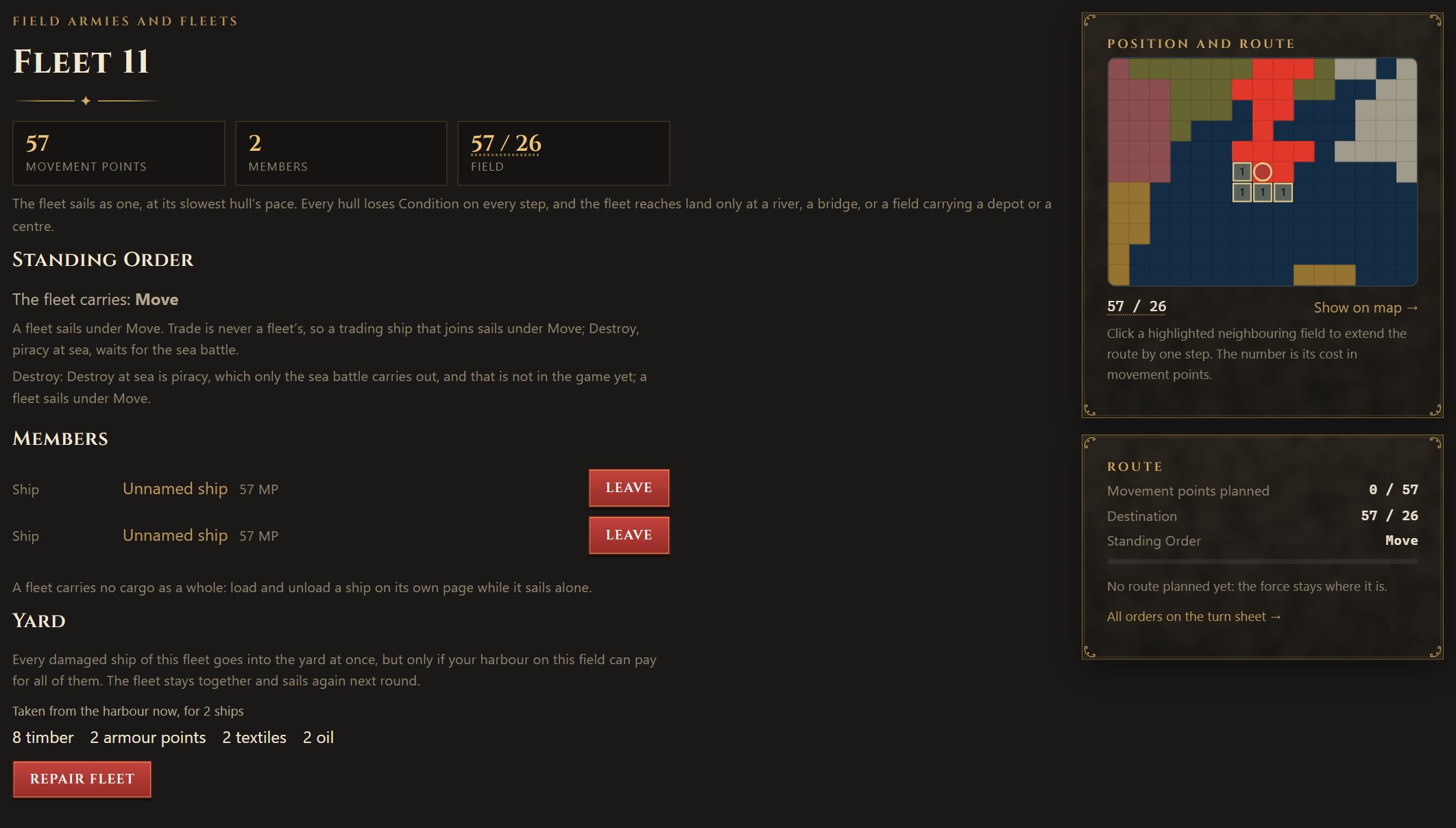
A fleet is a numbered group of your ships on one field, trading ships and warships alike, numbered 11 to 30. You form, join and leave fleets under Army → Field armies and fleets exactly as you do field armies, and every change takes effect at once. Ships and land forces never share a group.
- A fleet sails as one, at its slowest ship's pace, and every ship in it loses condition on every step. It reaches land, like a single ship, only at a river, a bridge or a field with a depot or trade centre.
- A fleet carries no cargo as a whole: load and unload a ship on its own page while it sails alone.
- Repairing a whole fleet: at a harbour of yours on its field, one click sends every damaged ship of the fleet into the yard at once, but only if that harbour can pay for all of them; the button shows what it costs. The goods are taken at once. The fleet stays together and sails on the next round.
- A ship that goes into the yard on its own leaves its fleet; the rest sail on.
Repair at a friend's harbour
A ship can also be repaired in another realm's harbour, but only by that harbour's owner, and only if the owner holds Friendship toward the ship's realm. The owner sees such ships under "Foreign ships in your harbour" on the field's page and pays the goods and the crew from that harbour. The ship's own realm cannot order a repair at a foreign harbour. The ship spends a round in the yard, and a voyage its owner planned for it that round is refused. Both realms' Round Reports record the repair. No other realm's ships are ever shown there.
Trains
A train carries goods over land: 1,500 weight of at most three kinds. Every realm starts with a few, standing at its depots and trade centres. Trains are part of a world once it runs them; until then they are shown, but cannot be built, moved or ordered.
- Building one takes a round at a finished depot or trade centre of yours, which pays 50,000 money, 200 citizens, 100 slaves, 500 timber and 1,000 horses. A world holds at most 1,000 trains, numbered 8001 to 9000.
- A train has 75 × condition movement points. Every field it enters off a road wears its condition by the land table of losses, own ground less than foreign; roads and caravan routes cost nothing.
- It loads and unloads at your own depot as a step of its march, and can join a field army, which then moves at its pace.
- A train left with fewer than 10 movement points after its march is destroyed with its cargo. Repairing at a store of yours on its field costs the build price times the condition it lacks and takes one round.
- Disbanding is possible anywhere: its cargo goes into your store on that field, or is lost. A train costs no upkeep.
Movement and the turn sheet
On the turn sheet and on each force's own page you give each legion, field army, ship, fleet, train and commander a plan: a sequence of steps in one of the eight compass directions. Each step costs movement points by terrain. The plan works out in advance exactly how far each force gets and what it loses on the way — and those figures match the settlement, as far as your own realm can know.
- Attrition: marching costs legions strength and ships and trains condition, by terrain; more abroad than at home, nothing on roads. Commanders lose nothing.
- Forced march moves a legion faster but costs more. It is allowed only inside your own territory.
- Loading and unloading: at depots a legion, ship or train can load and unload goods as part of its plan.
- Ships sail on water and reach land only at a river, a bridge, or a field with a depot or trade centre. Legions cannot march onto the open sea.
- You may enter foreign territory only where you have the right to; which right that is, see Diplomacy.
Conquest and its aftermath
Taking a field
- Neutral land: a legion, alone or in a field army, takes every neutral field it marches over for your realm, with or without a commander. A forced march never conquers.
- Enemy land is the land of a realm you hold War or Counter-war toward. Only a field army with at least one legion and a commander may march into it, and it takes every enemy field it enters, up to its invasion depth per round: a Roman field army with 1, 2, 4, 6 or 8 legions reaches 1, 2, 3, 4 or 5 fields, a barbarian one with 1, 3, 6, 9 or 12 tribes the same. Under Destroy it is at most 3.
- A field changes owner at most once per round.
When two realms take one field
You do not see the other realms' plans, so the turn sheet cannot promise a conquest. If two realms reach the same neutral field in the same round, neither gets it, and it stays neutral. If two or more realms take a field another realm owns in the same round, the owner loses it, but neither attacker gets it: it becomes neutral. The same holds when the winning side of a battle has two or more realms with a claim on the field. The buildings on it and the goods in its depot stay with whoever owned them; nothing is razed.
Where hostile armies meet
A march that runs into a hostile army that stood still on the field this round stops there and takes nothing, and hostile marches that end on the same field meet too: a battle decides the field. You cannot see foreign armies in advance, so a march can end early, on any land field.
What a taken field brings
- Everything standing on an enemy field you take passes to your realm: its depot with its goods, its manufactory, and any fortress on it. Under the Destroy Standing Order the manufactory or depot is razed instead (see Standing Orders).
- The citizens are lost. A taken depot or trade centre loses the citizens it stores, a taken manufactory its citizen workers. Its slaves pass to you, like every other good.
- No income for a month. In the settlement that takes it, the field pays no tax and its manufactory produces nothing. From the next month it earns for you. The World Map marks it as freshly conquered for that round, and it takes no orders yet.
- Both realms' Round Reports list the field and what was lost with its buildings.
Land battles
Land battles happen only in worlds where land war and diplomacy have been announced and switched on.
Two realms are hostile when either of them holds War or Counter-war toward the other, as the statuses stood when the round began. Their armies fight in the settlement, right after movement, when they meet on a land field:
- a march runs into a hostile army that stood still on the field this round. The march stops there and takes nothing, and the battle decides the field. This holds on any land field, your own included;
- hostile marches end on the same field in the same round.
Marches that only cross a field do not meet. Armies that already shared a field before the round do not fight again by themselves; that is what the attack order is for. You cannot see foreign armies, so the turn sheet cannot tell you whether your march will meet one.
The attack order
When hostile armies share a field, for example after a draw, you order the attack on the page of your legion or field army, under Attack on this field. The order covers your whole army on the field, once per field and round. It is queued, and you can withdraw it until the settlement.
- You can give it on any field where a ready legion of yours stands, because you cannot see foreign armies. The battle is fought in the next settlement if a hostile army still stands there. Otherwise the order lapses with the note "no battle", without saying why.
- It does not stop a march: what stays on the field attacks. If your whole army marches off, the order lapses.
- If your side wins, you take the field only with the right to take it: on enemy land as a field army with a legion and a commander, on neutral land with any legion.
Sides
Every legion and tribe a realm has on the field fights, loose or in a field army. Legions still being raised do not. A battle has two sides. The defender is the realm whose army stood on the field; if every army arrived this round, the field's owner, and failing that the army that spent the fewest movement points to get there. With three or more realms on one field, the realms hostile to the defender attack, and the realms hostile to an attacker stand with the defender. So two realms at war with each other can end up side by side for one battle.
The fight
A battle has six rounds: ranged, melee, ranged, then three of melee. Ranged rounds count only cohorts that shoot. In each round both sides strike at the same time, and each side's blows are spread evenly over the other side's cohorts. A cohort's combat value on the field's terrain, its strength and its experience decide how hard it strikes; its defence value decides how much it suffers. A cohort with half a man or less left is destroyed.
The result: for each side, the men it brought are divided by the men it lost. The side whose figure is higher by 2 or more wins; anything closer is a draw. Between armies of similar strength, expect draws.
After the battle
- Flight: the losing side's cohorts lose another 7.5% of their men, at least 25 each. A draw has no flight.
- Destroyed cohorts are removed, and so are legions and field armies left empty.
- Experience: one cohort in ten on the winning side, one in twenty on a side that drew or lost, gains a step, up to 9. The least experienced go first.
- Commanders: each side is led by its best commander on the field. For the battle he lifts as many of his own realm's cohorts by one step of experience as his Capability allows. If his side wins, his Capability rises by 2, up to 30. If his side loses half its men or more, flight included, he falls.
- Fortresses: a fortress on the field adds to its owner's cohorts' defence: +10 small, +20 medium, +30 large, +50 for a city fortress. If the owner's side loses, the fortress drops a tier, and a small one is gone; a city fortress becomes a large fortress for good. On a draw it drops a tier too, except a city fortress.
- The field: nobody retreats, so a beaten army stays where it stands. The field changes owner only if exactly one realm on the winning side has a claim on it: an army whose march this round entered the field with the right to take it (see Conquest), or one that holds that right and ordered the attack there. The new owner gets the buildings, as with any conquest. A draw takes nothing.
The Battle Report
Every realm that fought a battle reads its Battle Report, linked from the Round Report: the field and who defended it, both armies before the battle cohort by cohort, the leaders and the fortress, every combat round, the decision with both battle values, both armies after the battle with losses and flight, and the consequences for commanders, fortress and field. Both sides read the same facts; a realm that did not fight reads nothing. For one round the World Map marks the field on the map of each realm that fought there, and the Round Mail has a line for each battle.
Diplomacy
Diplomacy exists only in worlds where it has been announced and switched on. Until then every realm is Neutral toward every other.
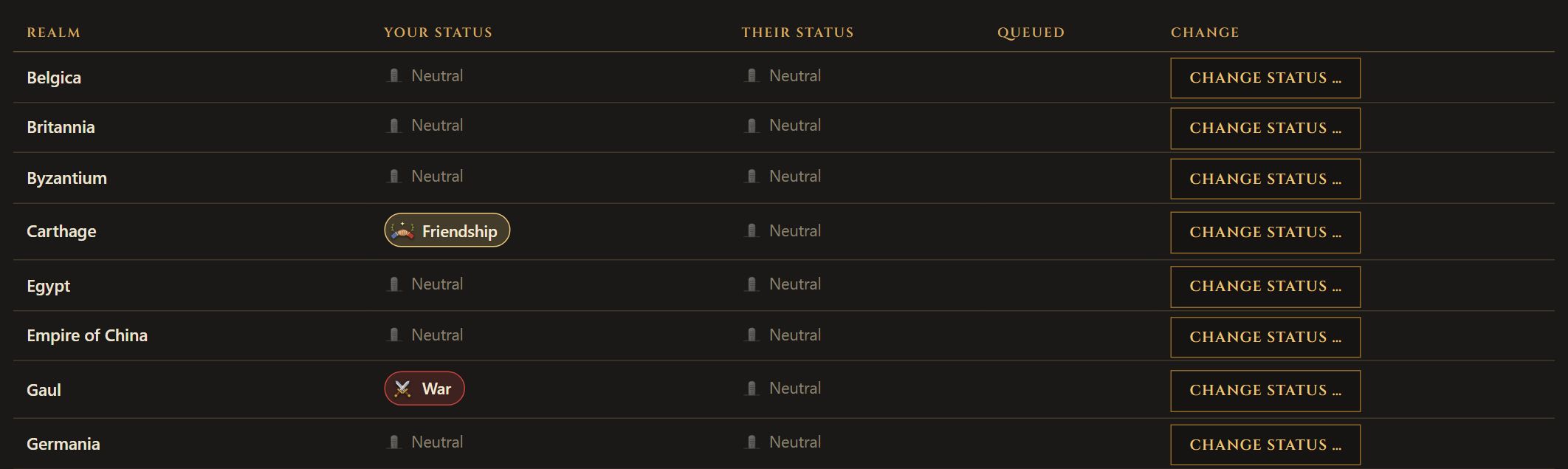
Between two realms there are two statuses, one in each direction. What you hold toward a realm decides what that realm may do in your land; what it holds toward you decides what you may do in its land. The two need not match, and each realm changes only its own. The Diplomacy page shows both for every realm. What two other realms hold toward each other you do not see. A realm taken over keeps its statuses.
The six statuses
 War
- Your field armies with a commander and at least one legion may invade that realm's land. Here your own status decides, not theirs.
 Counter-war
- Your answer to a War that realm declared on you. It works like War.
 Neutral
- Where every realm starts. That realm's legions, ships and trains do not cross your land. A commander on his own may enter any land, and a lone trading ship under the Trade Standing Order sails through at any status, War included.
 Trade
- Its trains and trading ships cross your land and may unload into your Depots.
 Military Alliance
- As Trade, and its legions and warships cross your land too.
 Friendship
- As Military Alliance, and its ships and trains may load from your Depots themselves, and you may repair its ships in your harbours. Only between realms of the same culture: Roman with Roman, barbarian with barbarian.
Changing a status
On the Diplomacy page, choose Change status on a realm's row. The dialog offers only what the rules allow this round and shows what each status does. The change is an Order:
- One Order per realm per round; a new one replaces the queued one. Until you end your turn you can withdraw it.
- It takes effect when the round is settled and is checked against the statuses as they stood when the round began. Two steps in one round, such as from War through Neutral to Trade, are therefore not possible.
- The Round Report shows which changes took effect, which were refused and why, and which realm changed its status toward you.
Which change is possible, and when:
- Between Neutral, Trade, Military Alliance and Friendship in any direction, skipping steps if you like, for example from Neutral straight to Friendship.
- War can be declared from any of those four, no earlier than in the orders for Aprilis 200.
- Counter-war is possible only against a realm that held War toward you when the round began, with no waiting period and whatever its culture.
- From War or Counter-war there is one way out: back to Neutral, which is never refused. Trade or more has to wait for the next round. A war is over only when both sides have retracted it.
- Friendship only with a realm of the same culture.
- Cap: you hold Military Alliance or Friendship toward at most 3 realms in the years 200 and 201, at most 4 in 202, and without limit from 203. The count is the realms you hold that way at round start, the ones queued this round, and the realm in question.
- Once the senate is built, every change needs its approval. Until then no change fails for lack of it.
Epidemics
Epidemics are not part of the Original. A world has them only if an Announcement has switched them on.
In such a world 6 to 8 epidemics strike every month, anywhere on the map and whoever owns the field; several may strike the same field. Each lowers the field's population density by one level, down to 0, and halves the citizens and slaves working in the manufactory on it. An epidemic on water or empty land does nothing. Your Round Report lists your manufactories that were struck and the workers lost; the World Map changes list every struck field, for everyone.
Trading at the market
If you hold a finished trade centre, you can buy and sell goods there with the merchants. Money and goods come from that province's depots and go back into them.
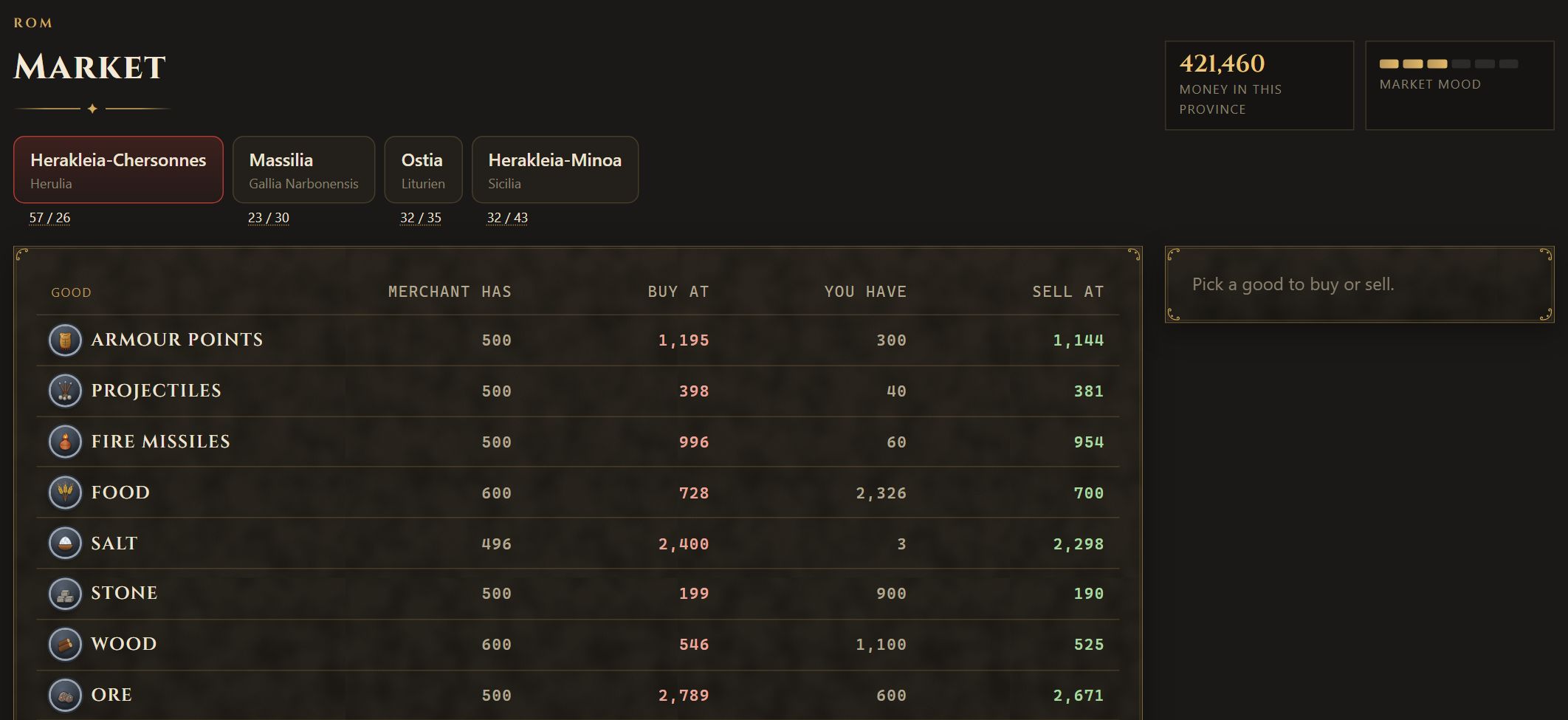
- The market mood changes every month, by at most two steps. The higher it is, the more everything costs, both buying and selling.
- Selling in bulk lowers the price you get per piece.
- A trader can only sell what it has in stock.
- Each month the population buys up part of any good a trade centre holds in large amounts, so a full market empties again. It never buys everything, and nobody is paid for it.
- Now and then a travelling merchant stands at one of your trade centres for a month; the list of centres marks where. It trades like the centre, with its own stock and a mood that can jump anywhere from 1 to 6, then moves on to another trade centre.
- Everything but money and citizens is traded, so slaves are too.
Still to come
These parts of the Original are not playable yet (as of 12 November 2026):
- Battles at sea, piracy included
- Trade by ship or train at other realms' trade centres and with the merchants standing there. Today you trade only at your own trade centres, as described above.
- For trains: capturing foreign trains, and the Trade Standing Order for trains.
- In diplomacy: a Depot's owner loading foreign ships and trains that stand there
- The senate, with approval and gifts
- Spies
- Fortresses in the open field, which are to get their material from trains (trains exist, the fortress order does not use them yet)
- Swapping the registration numbers of two of your forces of the same kind, ship with ship or train with train; today only legions and commanders can be renamed.
- Embarking legions onto ships, ceding territory
Built and on in every world from round 1: diplomacy, land war with commanders, field armies, Standing Orders, conquest and land battles, trains, fortresses, the caretaker, and the loss of understrength cohorts and legions. A world opened before one of them was built gets it only by an Announcement. Epidemics are built too, but are not part of the Original: a world has them only by an Announcement.